|
The
Condo News print newspaper is published every other Wednesday. It is circulated throughout Palm Beach County, from
Delray to North Palm Beach, and from Singer Island, Palm Beach and
South Palm Beach to Royal Palm Beach, in Condominium, Cooperative
and Home Owner Association Communities. For more information, or to
have the Condo News brought to your community, e-mail us or
write to: P.O. Box 15826, West Palm Beach, FL 33416. Tel:(561)
471-0329 |
|
|
On
this page:
•
Nature's Beauty - Photos
•
Condo
Pet of the Week (2015-2016)
•
Condo Art Corner - (2015-2016)
•
Condo
Pet of the Week (2014)
•
A Tribute to My (late) Father,
Part
1 - An outline of his career
Part
2 - My Early Education as an Army Brat
Part
3 - MASH in Korea: My Dad Goes to War
•
150th Anniversary of the Battle of Olustee, Fla.
~
A Moment in Time by Bernard Weixelbaum, reprinted from Condo News
March 14, 2001
•
Profile: Meet Lynelle Chauncey Zelnar -- founder of Forgotten
Soldiers Outreach
•
Condo Art Corner - 2014
•
Reflections of Mother
Parts
1 & 2
a
two-part series by Betty Thomas, Condo News Publisher
|
SCROLL
DOWN TO READ STORIES / VIEW PICTURES |
|
Nature's
Beauty
Photo
by Jimmy Shirley |
 |
|
This
fawn was spotted by Condo News photographer Jimmy
Shirley at Okeeheelee Nature Center in West Palm Beach. |
|
Condo
Pet of the Week - 2015-2016 |
 |
|
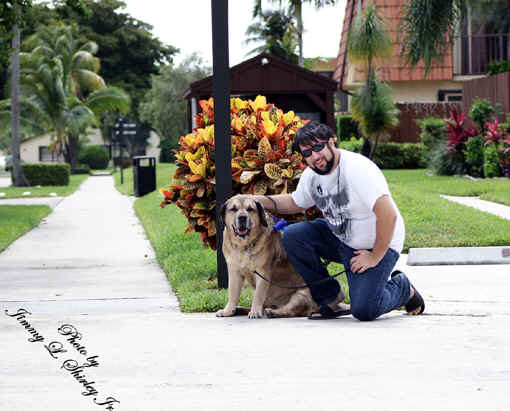
Ryan
Levinson lives in Springdale Homes with Benji, his lab/mastiff
mix.
Benji
is 11 years old. Ryan adopted Benji, a rescue dog, 7 years
ago. |
 |
|
Photo
by Jimmy Shirley
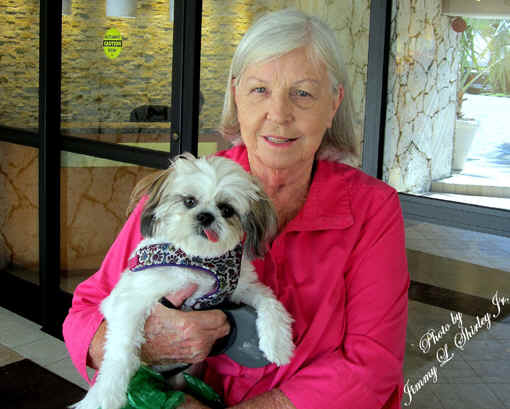
Sake,
a 1½ year old Shitzu, lives with his owner Sarah Knowles. They
have lived at Dorchester N. condominium on S. Ocean Blvd., Palm
Beach, for 10 months. Sarah came to Palm Beach from Vero Beach
where she lived for 40 years. |
|
Condo
Art Corner - 2015-2016 |
|
We
invite you to submit a photo of art that you have
created --
painting,
sculpture, drawing, artistic photo, carving,
etc.
Please
submit your item as a .jpg with 300ppi
resolution
by
email to: info@condonewsonline.com.
In
the subject line please type "Art
Corner."
Include
a title for your item and the medium you used.
Submissions
will appear first in our print paper
and
then on our website.
Amateur
artists only, please.
|
|
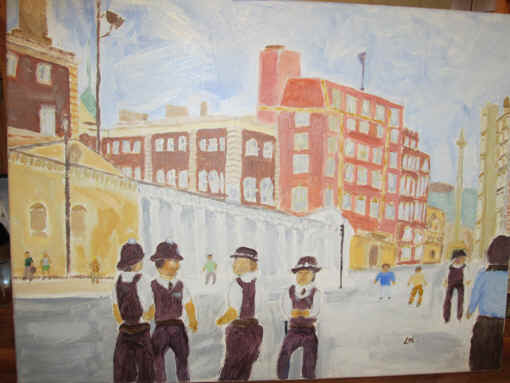
"English
Street Scene"
Acrylic
on canvas
by
Lee Malkin
Mr.
Malkin paints with the Silver Eagles at the Palm Beach Mid
County Senior Center on Lake Worth Road, Lake Worth. The
Silver Eagles is an art class for seniors offered at the
Center. They paint on Mondays from 8:30 am to 12 noon.
Mr.
Malkin is a resident of Arbors on Cresthaven Blvd.,
West
Palm Beach, and has been painting for 7 years. |
|
|
|
"Dimensions"
A
3D picture, or collage, using clippings from magazines and other
media. "Dimensions" is a picture of Times Square in
New York, explains artist Saul Tilson. He cuts out different
pieces of art from magazines and pastes them on a surface to
build his picture. His friends also give him pictures he may
want to use for his art form. He has many other 3-D pictures on
the walls of his home at Poinciana Community Center in Lake
Worth, FL. |
 |
|
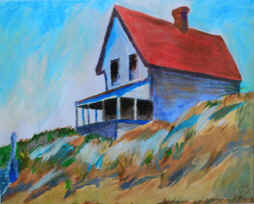
"Beach
House"
Acrylic
Water Color
By
Loyal E. Whiteside, age 92. Mr. Whiteside never
painted until he moved to Lake Worth Gardens where he
has been a member of their art class since 2012. He
has always been color blind, yet his choice of colors
is spot on. |
 |
|
Condo
Pet of the Week (2014) |
 |
|
Photo
by Jimmy Shirley
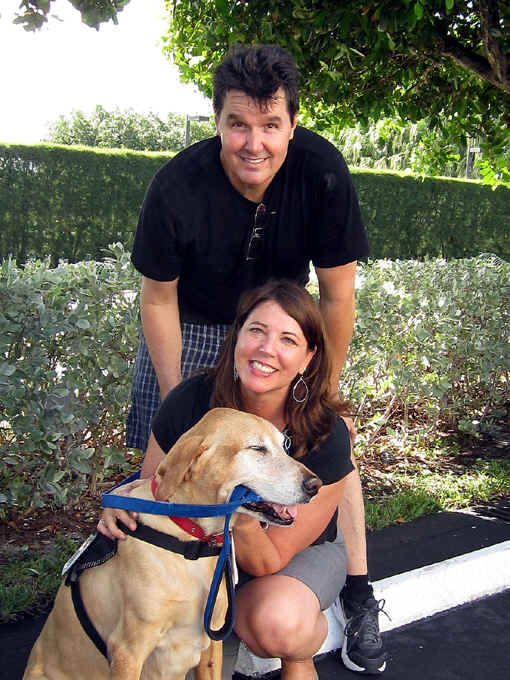
Eli
is a 12 year old red field lab rescue dog and certified
emotional support dog. He lives with his owner, Doug Ramsey and
Doug’s wife Kelly at the Dorchester South condominium on South
Ocean Blvd. in Palm Beach. The Ramseys have lived at the
Dorchester for 2 months after moving from Wellington where they
lived for 10 years. The couple have been in business making
custom furniture for 28 years. |
|
Lt.
Col James A. Bell
1915 - 1981
U.S.
Army Medical Corps
A
Tribute to My (late) Father
By
Betty Thomas |
|
(June
11, 2014)
Part
1 - Outline:
My
dad was an army brat born in San Antonio's Ft. Sam Houston
Army base. His father was an officer in the U.S. Army for 30
years and helped Pershing chase Pancho Villa across Texas. My
father as a child spent many years (9) in Manila where my
grandfather was stationed.
It
was expected that my dad would follow in his father’s
footsteps. He chose the medical corps as his career. He took
his pre-med in Ann Arbor, Mich., where grandpa was stationed,
and studied medicine at the University of Santo Tomas in
Manila. Then, at the University of Texas School of Medicine in
Galveston, he got his M.D. It was there that he met and
married my mother, and where I was born.
Dad
did his internship at Walter Reed Army Medical Center in
Washington, DC. During this time, I stayed with my
grandparents in Dallas, Texas.
He
was then transferred to Carlisle Barracks, Carlisle, PA, at
the Medical Field Service School (MFSS). This is where interns
and medics were trained to be officers. He went into the
school as a 2nd Lt. and finished as a 1st Lt. Carlisle
Barracks was not attached to any other unit, therefore, the
doctors were allowed to be armed. During this tour of duty, my
mother traveled to Texas to bring me to Carlisle.
(**
Photos are frames extracted from my father's 8mm movie film.)
|
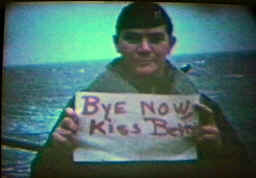
In
1945, my father was sent to Germany as part of the
occupational troops. He was attached to the 98th
General Hospital in Munich. Mother and I followed in
July 1946. I was 4½ years old. (Pictured at right:
Dad aboard the military transport ship on the way to
Munich.)** |
 |
We
lived in Munich for about two years (mother and I) and dad had
been there for 1 year before us. In 1948, we were transferred
to Bad Tölz, to the (Flint) Kaserne and my father was
promoted to Captain.
|
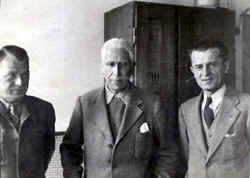
While
in Bad Tölz, my father had custody of Franz von Papen
(pictured at right in center), a German politician and
diplomat from the Catholic Center Party. Papen served
the German government as Ambassador to Austria from
1934-1944. He was captured by the allies after the war
and was one of the defendants at the Main Nuremberg
War Crimes Trial, but was acquitted. |
 |
My
father’s responsibility was to keep von Papen healthy and
fit so he could be tried.
In
1949, we were transferred to the Presidio in San Francisco,
Fitzsimmons Hospital. Dad was promoted to Major and served as
commander of the hospital. We remained there for a year when
we were transferred to an area near Concord, California. Soon,
Dad got his orders and was sent to command a M*A*S*H hospital.
He was involved in the Hungnam evacuation. He served in Korea
for two years, until 1952.
When
he returned from Korea, we were transferred to Ft. MacArthur
in San Pedro, California, where he took command of that
hospital. We were there for 1 year.
From
there, we went to Ft. Sam Houston in San Antonio, Texas, where
Dad, again, took command of the base hospital. Dad was
promoted to Lt. Colonel.
Our
next tour of duty was in Washington DC at the U.S. Soldiers’
Home (now the U.S. Soldiers’ and Airmen’s Home). By now, I
was in the 7th grade. My father was deputy chief surgeon. I
spent a good deal of my spare time down at the hospital with
the Daughters of Charity nuns (they were the nurses at the
hospital) and some of the patients with whom I had become
friends. I was profoundly inspired by these men. There were 3
wards in this wing. Wards 7 & 8 had the "normal"
patients. Ward 9 was where the mental cases were. Dad only let
me go up there when he did his rounds. One day, one of the
Ward 9 patients was shuffling down the hall mumbling to
himself: "I’ve been in this man’s army 34 years. I’ve
seen ‘em kilt, buried and blown up again. I’ve been in
..." I realized that combat may scar a man’s soul for
life.
One
day, Dad called home and asked me to come down to the hospital
right away. He had someone there he wanted me to meet -- a new
patient. This man was in a small private room. He was very
old. He had been severely wounded by a grenade during his
combat years. He had lost his eyes, part of his jaw, and both
hands half way up to his elbows. Dad asked him to show me how
he puts oil on his head; then how he drinks his soup (in a
cup). Then dad told me that he makes his own bed all by
himself. The man concurred. Dad said to me, "He has no
eyes or hands and still he makes his own bed. You have two
eyes and two hands. Why can’t you make your own bed?"
Point well made, and taken.
After
Dad left the Soldiers’ Home, he was stationed for a year at
Ft. Meade in Maryland. We moved to Riverdale, Md., where my
parents bought their first house. After 1½ years, we got
orders for Germany. But, after packing and shipping our
furniture over, our orders were changed and we were redirected
to Teheran, Iran. There, dad was attached to Military
Assistance Advisory Group (MAAG). The United States Army
Mission Headquarters (ARMISH) was also there. They provided
the Ministry of War and the Iranian army with advisory and
technical assistance to enhance their efficiency. MAAG was
established to administer the program. Later, the two missions
were consolidated into ARMISH-MAAG and remained active until
the Islamic revolution in 1979. Basically, my dad’s job was
to examine the Shah’s air force pilots. His command was a
25-bed hospital for the American dependents and personnel, in
which I promptly became a patient of before he took command
with a terrible case of what was called the "T-Ts"
(Teheran Tummy). Actually, I now think it was e-coli that I
picked up in Italy at the California Cafe from a really
under-cooked hamburger.
My
experience in Teheran was a real eye-opener. I went to the
Community High School run by Presbyterian missionaries, whose
students were all college bound. The lessons were in English.
Students were Iranians, Arabs, Jewish, Russian, Polish,
Romanian, Iraqi, East Indian, etc. The Americans there (except
for me) were either American Embassy kids, Esso employees
kids, or other civilian businessmen’s children. They seemed
very snobbish to me. I really liked the International group
better.
We
returned to the U.S. after one year and Dad was stationed at
the Pentagon. Shortly after our return, my parents separated,
and after 4 years, divorced. See, things were never the same
after Korea. War does that. Dad retained his rank of Lt. Col.
until his retirement after 25 years of service.
Being
an only child, I would often spend spare time reading Dad’s
medical books. Dad suffered from chronic bleeding colitis
after Korea and was not given enough time to recover
completely before being given command of the hospital he had
been a patient in -- Fitzsimmons in San Francisco. He was a
very compassionate man -- to a fault. He often mourned a
patient he lost, and would talk about it at home -- even cry.
I saw his agony manifested and what I now know to be PTSD
which went untreated by the then VA. In 1981, he suffered a
massive myocardial infarction (heart attack). He had remarried
and had a son with his second wife, Alma, also a veteran.
My
childhood was not the usual kind, but I learned much from our
travels, from other cultures and from my father’s
compassion. I saw his love for his veteran-patients that he
demonstrated every day.
***
(June
25, 2014)
Part
2 - My Early Education as an Army Brat ...
In
Part 1, I introduced you to my late father who was a career
Army Medical officer. The article outlined his career of 25
years.
I
would like to pause at the various stations and share a little
of that experience with you.
Once
Dad completed his training at the Army War College in
Carlisle, PA, he was sent to war-torn Germany as part of the
post-war occupational troops. That was some time in 1945. Once
it was deemed safe for the dependents, mother and I were set
to join him in Munich. However, a few days before we were
scheduled to sail, I became ill with a high fever and mother
put me in the base hospital. I remember being in a crib with
bars. Mother told me we couldn’t go until I was well. The
next day, the fever was gone and we would be on our way. I was
about 4 years old. We sailed on the Ben Alexander, a military
transport ship that, as mother told me later, had a round
bottom instead of a keel. It was very unsteady and rolled
around a lot.
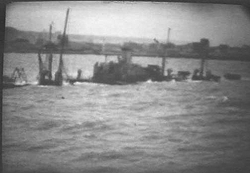
**
Photos are frames extracted from my father's 8mm movie film.
| Sunken ship in German harbor** |
 |
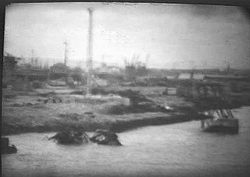 |
Bombed
German coastline** |
|
Photo
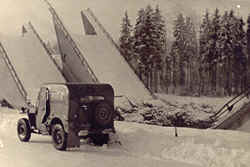
of German bridges reportedly destroyed by Gen. Patton. |
 |
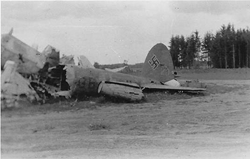 |
Photo
of German fighter jet - the Messerschmidt. was the
world's first operational jet powered aircraft. |
When
we arrived at our destination in Germany, evidence of the war
was all around. The harbor was littered with sunken ships, the
landscape was reduced to piles of rubble, and there was a
stench. When on the transport bus that took us to meet
"Daddy", I remember seeing a woman with a wool
"babushka" (scarf) on her head picking through the
rubble. I also remember asking mother what that awful smell
was. She explained that it was from the bombed-out buildings
and everything that was in them. Death.
In
Munich, our house, which had been appropriated by the U.S.
Military, had belonged to a friend of Adolph Hitler. It was a
big two-story house with a basement. I don’t remember the
basement, but mother told me it had a lot of Oriental art
stored in it. Also, part of the roof had been blown off. There
were burned marks on some of the upstairs floors. Mother kept
a garden in the back yard with flowers and some vegetables. I
remember rhubarb. It looked like red celery.
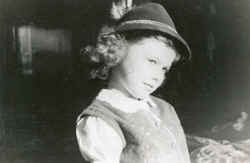 |
Betty
in Bavarian
traditional
outfit
(age
approx. 5 years old) |
The
economic situation in the country was as one might expect --
no currency, no gasoline, cities leveled. Quite austere. The
locals did what they could to make money. Many took scrap iron
from the bombed buildings to fashion items they could barter
with on the black market, others painted on whatever materials
they had available. My parents purchased many paintings and a
lovely wrought iron table with ceramic tiles from all of the
factories, including Meisen, with Alpine flowers painted on
them. Our "currency" consisted of cigarettes,
stockings, chocolate, etc. One day while I was at a friend’s
house, a German man came with two little dachshund puppies,
one red and one black. I was "fixed" on the black
one, and when the little girls’ mother opted for the red
puppy, I scooped up the black one and, followed by the German
man, ran home and breathlessly declared to my mother,
"This is a little black puppy, and I always wanted a
little black puppy, and he only costs 5 packs." (It was
actually 5 cartons, but what does a 5 year old child know
about "money?") We had Ricky for 11 years.
**
Photos are frames extracted from my father's 8mm movie film.
|
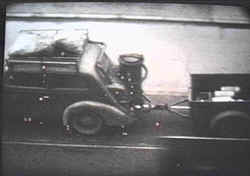
Car
with "still" attached** |
 |
|
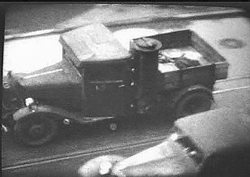
Truck
with "still" attached** |
 |
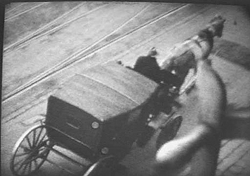 |
Horse
and buggy --
no
need for a "still" ** |
To
provide fuel for vehicles, and being that the only ones that
had gasoline were the occupational forces, the Germans used
stills that burned wood and looked like hot water heaters
attached to their vehicles. (See photos on page 6).
Apparently, that was customary throughout Europe at the time.
There
were no schools for the dependent children, so the wives
formed a nursery school and kindergarten. I learned my first
"cut and paste" there. Those familiar with
publishing before computers will appreciate that. Mother took
language classes to learned German and I learned it as a
matter of course. It was the Bayerisch (pronounced Buyerish)
dialect spoken in Bavaria. Once in the U.S., I refused to
speak German -- I was an American! That is unfortunate in that
I lost that language.
Some
time while in Munich, Mother and Dad, and another couple, took
a 6 week vacation to Italy. I was left behind with Annie, the
woman who took care of the house and me. I remember missing
them so much, but Annie was a very loving woman. She kept up
correspondence with my parents for a while after we returned
to the U.S. Dad, Mother and their friends, the Escolas, met
Pope Pius XII while in Italy. They also went skiing there and
in Germany, as well as hunting. Pheasant, duck and deer were
in their sights. Ricky, our dog, turned out to be an excellent
hunter, too. He would flush out the pheasant for them. I
remember a particular duck my father brought home. He was a
beautiful mallard with a green head. I was so upset at the
death of this magnificent creature that I asked for the head
to keep. They allowed it and I would pet the poor thing and
then put him in a cubby where the telephone was for a while
and retrieve him later. But, alas, as my parents expected,
poor duck began to stink. So I asked my parents to dispose of
him. Being that I was small, I remember a lot about my mother’s
clothes (mostly from the vantage of my height). I clearly
remember her shoes and ski boots, and the "British
Walkers" she wore. (A thick heeled medium high shoe.)
We
stayed in Munich for about 2 years before being transferred to
Bad Tolz -- the Kasserne, as the base was called. There was
less destruction there. I went to first grade where I remember
being taught German script. Our stay in Bad Tolz seemed
uneventful in my memory.
In
1949, we were transferred back stateside. We sailed on the
General Patton via the North Sea. We encountered a force-12
gale and, according to mother, ships were going down all
around us. I remember one morning we were waiting for the
second breakfast seating when a wave broke through a window
and swamped two sailors with seaweed and mud. I have a picture
in my mind of the waiter holding a tray, trying to keep his
balance with seawater, seaweed, fish and mud rushing back and
forth on the floor and one cream pitcher rolling around. I don’t
remember if we got to eat.
Being
an only child of a military officer in post-war Germany was an
experience that gave me an understanding of the world quite
different than the usual. I think it still affects my view of
the world’s conflicts and man’s struggle to adapt to
ever-changing scenarios. For sure, I feel fortunate for the
education.
To
be continued ...
(July
9, 2014)
MASH
in Korea — My Dad Goes to Korea
In
1949, my father was transferred stateside, to the Presidio in
San Francisco and became the commanding officer of Fitzsimmons
General Hospital there. We stayed there until mid 1950 when we
were transferred to Concord, Calif. The Concord Army Air Base
was located there and served as a staging area for troops who
were being deployed to Korea.
Dad
was the first commanding officer of the 1st MASH unit in Korea
at the beginning of the war and stayed until it ended. I
remember mother sending him the Sunday "Terry and the
Pirates" comic strip, as well as other items he needed.
One of those was an electric razor because the shaving cream
would freeze in the winter. They could hook the shavers up to
the Jeep’s battery.
While
there, my Dad made use of his movie camera, documenting what
he could during the lulls. He also brought home lots of
photos. Here are some of them - some from the movie film..
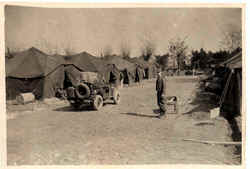
Field
Army Medical Service (MASH)
Mobile
Army Surgical Hospitals (MASH), operated under tents close to
the divisions they supported
|
A
photograph of Dad’s MASH unit. |
 |
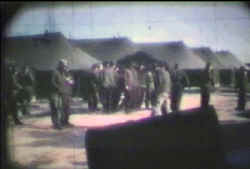 |
A
frame taken from
Dad’s
movie film depicting
Dad's
MASH unit. |
|
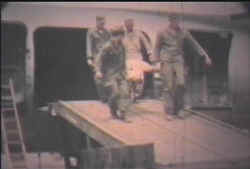
Incoming
wounded arriving by air transport. Patients
were treated by medics on the battle field, then they
were sent to a battalion aid station before being
transported to the MASH unit for more extensive
treatment. |
 |
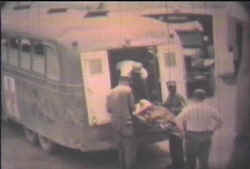 |
Patient
being loaded onto an "ambulance" |
|
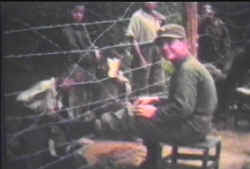
Local
children often earned some money by offering to shine
the boots of the MASH doctors. Here, Dad is getting
his boots shined by the local children. Notice a small
camp dog next to Dad. |
 |
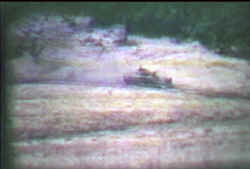 |
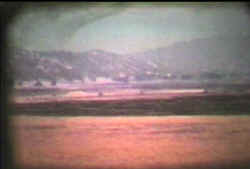
An
interesting clip on Dad’s movie film was a tank
battle sequence filmed from a vantage point on a hill.
Pictured here is a frame from the film showing a tank
headed for the battle. |
|
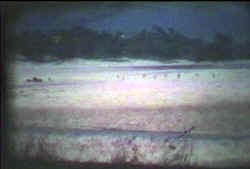
Another
frame of the tank battle shows several tanks and the
puffs of smoke where their mortar is landing, clearing
the way for the ground troops. |
 |
 |
This
frame shows troops on the ground following the tanks
into battle and one tank bringing up the rear. |
|
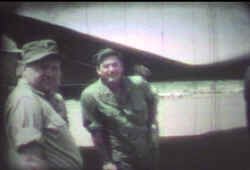
The
USO Arrives in Korea:
Errol
Flynn, center of photo, was part of the U.S.O. team.
Dad was there with his movie camera when they arrived.
Errol Flynn is seen leaning on his cane. He had a very
bad limp then. |
 |
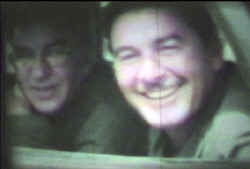 |
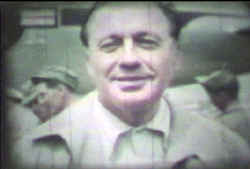
Errol
Flynn smiles broadly
at
the camera |
|
Jack
Benny came over to say a few words to the camera
(Dad's). Too bad there was no sound. (Errol Flynn can
be seen in the background) |
 |
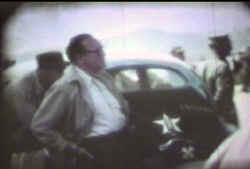 |
Jack
Benny and others near one of the cars that would take
them to the camp site. |
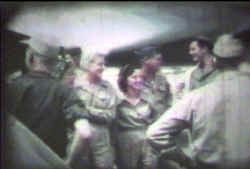
|
Betty
Grable, Errol Flynn and others. |
 |
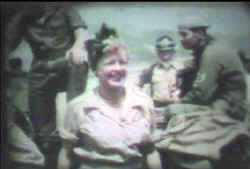 |
Betty
Grable |
|
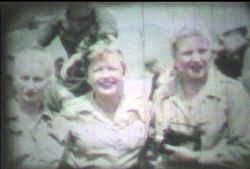
Betty
Grable in center with two blonde entertainers.
(Can
anyone identify the two blonde gals with Betty Grable?) |
 |
 |
Fans
of the TV series, M*A*S*H, may remember Jamie Farr’s
character, the cross-dressing Corporal Klinger who was
hoping to get discharged from the Army by wearing
women’s clothes.
There
was a real-life female impersonator shown in this
photograph. Very convincing, said my father. |
Frames
from Dad’s "home movies"
--
A
note about the frames extracted from Dad’s movie film ... I
had enlisted a company whose business it was to make video
transcripts from court testimony to transcribe my parents’
home movies that were taken with their 8mm camera over a span
of about 13 years. The fellow told me that it took hours and
became somewhat tedious (I had about 16 reels of film. Mother
had edited and spliced all their movies into that collection.)
Then, suddenly, on my "home movies" -- up popped
Errol Flynn, Jack Benny, Betty Grable -- and they said they
were agast! What a treasure, they told me. (The process cost
me over $300.00, but I made copies for my children.) I had
them put on DVD, then selected frames to be extracted from the
videos. The frames are blurry, but, at least we can see the
images of those events.
|
|
150th
Anniversary of the Battle of Olustee, Fla, Feb. 20, 2014
By
Betty Thomas |
|
Thursday,
Feb. 20, 2014 is the 150th anniversary of the Battle of
Olustee, the bloodiest battle of the War Between the States
(commonly known as the Civil War) in Florida. The following
article was written by former Condo News columnist,
Bernard Weixelbaum and published in the Condo News on
March 14, 2001.
The
annual reenactment of that battle took place in Olustee,
Florida, this past weekend. Condo News representative,
Jimmy Shirley, and I participated in the reenactment (Jimmy
and I are long-time reenactors).
A
story by Palm Beach Post reporter, Eliot Kleinberg,
relating the link that Mr. Weixelbaum and I have through our
ancestors, and the connection that we had through the Condo
News, appeared in the Post on Saturday, Feb. 15,
2014 on page one of the Local section He and his photographer,
Thomas Cordy, covered the reenactment. Another story about the
reenactment itself is forthcoming in the Post.
Bernard
is now living in New York state with his wife Dickie near
their son Elia Weixelbaum. Bernard and I are forever linked
through our ancestors’ DNA that fell on that battle field
150 years ago, and through our association in the Condo
News.
Read
on ... |
|
A
Moment in Time
By
Bernard Weixelbaum,
reprinted
from Condo News, March 14, 2001 |
|
Betty
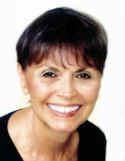
Thomas |
Bernard
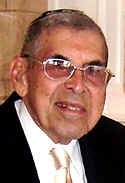
Weixelbaum |
Bernhard
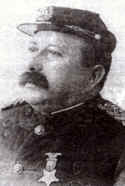
Weichselbaum |
James
Monroe "Bud" Davis |
|
February
20, 2001, was the 137th anniversary of the battle of Olustee,
Florida. The year, of course, was 1864. The battle of Olustee,
or Ocean Pond as it is also referred to, was a pivotal battle
in the Civil War, resulting from an attempt by the Union Army
to cut Florida off from the rest of the Confederacy. There
were 1861 casualties among the Union soldiers, while the
Confederates counted 946. Every year since 1976 there is a
commemoration of the battle on the actual battlefield.
Thousands of Civil War buffs and descendants of the original
protagonists reenact the details of the battle in authentic
dress, bearing true replicas of the weaponry.
Back
there on that cold February day in 1864, there were 2 men in
particular, on opposing sides, of whom I relate. One was a
young Jewish immigrant who was born on May 3,1841 in Bavaria,
Germany, and had enlisted in New York on July 20, 1862 for a 3
year stint. He trained with Company G, Independents Battalion,
Light Infantry, N. Y. Volunteers, an outfit known as "Enfans
Perdus" and comprised primarily of men of the same
ethnicity. On January 30,1864, upon completion of his
training, he joined the 47th Regiment, NY Volunteers,
Infantry. He never rose above the rank of private. His
opponent was born in Georgia on May 19,1841. On June 26,1861,
he enlisted and was mustered into the 19th Georgia Regiment,
Co. E, Colquitt’s Brigade. In the course of his military
career, he was captured at Fredericksburg, Va. on December
13,1862, but, in what was presumably a prisoner exchange, was
released on the following day. Although he had encountered so
much action, he, too, remained a private throughout his
military career.
On
that fateful day of February 20, 1864, Private James Monroe
Davis (that was his name), found himself in Olustee, Fl. as
part of Co. E, 19th Regiment, fighting a fierce and determined
army of blue clad soldiers. Almost directly opposite his
position was Co. A of the Union’s 47th Regiment. Of course,
this is purely conjecture and highly unlikely and improbable
but certainly possible. What if, in the heat of this bloody
confrontation, these two men faced each other on the field,
simultaneously firing their weapons at each other. Yes, it is
entirely possible because, strangely enough, both men were
wounded in this battle, each man suffering a thigh wound.
Of
course, you can see there are so many other parallels to this
history; both men are only 16 days apart in age; both men
suffered the same type of wound and both men were taken
prisoner though not at the same time. Our young immigrant was
captured in this very battle at Olustee and confined in the
infamous Andersonville Prison.
You
may have wondered why I have singled out these two soldiers.
Perhaps you have already guessed that the young German
immigrant was my grandfather, Bernhard Weichselbaum, but did
you also surmise that James Monroe Davis was the great-great
grandfather of the Condo News publisher, Betty Thomas,
who has rightfully retained the same justifiable pride in her
heritage as I have in mine? One other interesting sidelight,
James Monroe Davis died on March 1, 1923, just 3 days before
the birth of Jerry Heacock, the former publisher of the
Condo News and, consequently, former employer of Betty
Thomas. |
|
Meet
Lynelle Chauncey Zelnar Founder
of Forgotten Soldiers Outreach A
profile by Betty Thomas |
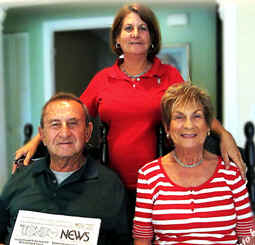 |
David,
Lynelle and Marcia Chauncey
Photo
by Jimmy Shirley |
|
(November
27, 2013)
Lynelle
Chauncey Zelnar was born in Chicago, Ill., of David and Marcia
Chauncey, formerly of Brookline, MA. During our visit with
Lynelle and her parents at Lynelle’s home in Lake Worth,
Marcia described Lynelle as "the type of child you could
have over and over." "She always had a big heart,
always giving, always wanting to help others," added
David. Her mother described her as having a "social
worker’s mentality."
That
formula was played out as Lynelle grew from childhood to
womanhood, as evidenced by the milestones of her life’s
path.
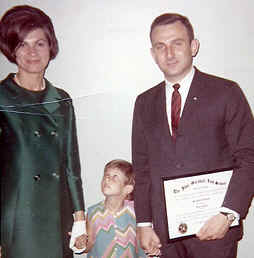 |
Marcia
and David Chauncey with Lynelle, age 3. Photo was
taken when David graduated from law school. Mr.
Chauncey practiced business and banking law in Chicago
and in Florida. He retired in 1999. Mrs. Chauncey was
an Elementary school teacher and retired from the
Florida system in 1999. She taught from 1959-1999 at
University of Chicago Laboratory School and Palm
Springs Elementary in Florida up to the time she
retired. |
During
the Vietnam War, when Lynelle was in 3rd grade, she wrote a
letter to President Nixon petitioning him to bring our troops
home. She recalls that she and her friends would cry upon
hearing that someone’s father had been killed.
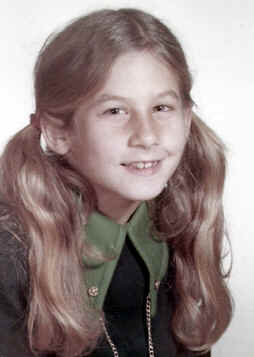 |
Lynelle,
age 8 |
In
5th grade, POW bracelets became popular and, Lynelle says,
that planted a seed.
When
Lynelle was 11 years old, the Chaunceys moved to Palm Beach
National in Lake Worth where Lynelle grew up with her younger
sisters Heather and Andrea.
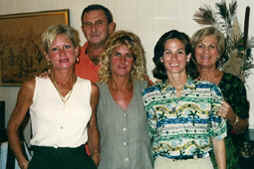 |
L-r:
Andrea, David, Lynelle, Heather
and
Marcia Chauncey in 1985. |
At
age 11, in 1975, Lynelle’s sister’s friend came down with
cancer. Lynelle organized a "carnival" to raise
funds to help with her treatment.
Lynelle
continued on her path and pursued a degree in Sociology and
worked with delinquent children. She interned at a prison in
North Florida and then worked with a short term offender
program called Alexander Creek Stop Camp.
Back
in Palm Beach County, Lynelle had intended to become a private
investigator, but instead became a community association
manager.
On
August 11, 2001, Lynelle married Bill Baggett, Jr., son of the
director of Royal Palm Memorial Gardens, Bill Baggett, Sr. and
his wife Bea, who hosted the largest Memorial Day Service and
Wreath Presentation ceremony in the state of Florida for many
years. Exactly one month after their marriage, 9/11 happened.
Then on Oct. 7, 2001, the U.S. launched Operation Enduring
Freedom in Afghanistan, and then the invasion of Iraq on March
20, 2003. A friend’s son was killed in Iraq and it hit
Lynelle hard. It became the catalyst that brought Lynelle to
form Forgotten Soldiers Outreach in Oct. 2003. FSO was
officially designated a 501c(3) on January 12, 2004.
Good
Morning America featured FSO on
their show in March 2004, then the media took off with
national news, e-mails, phone calls.
At
the R.P. Memorial Day ceremony in May 2004, Lynelle and Bill
announced the formation of FSO. Lynelle had just learned that
she was pregnant. Son Bryson was born Dec. 3, 2004.
Still
working for the property management company, a co-worker’s
son, Kristopher Knight of Lake Worth, with the 173rd Airborne,
was among the first deployment of troops to Iraq. Knight was
calling home extremely depressed with what he was seeing, and
experiencing, especially when many of his brothers in arms
were not receiving much support from home. That was Lynelle’s
inspiration to send care packages to Knight and his two
buddies. She worked out of the property management offices,
after hours with the permission of the owners. Then other
friends came to help, then teachers came on board providing
letters written by children in their classes. Then, with the
deployment of the local National Guard 124th Bravo to Iraq,
more names and donations started coming in. They needed more
space.
All
the necessary legal and accounting services were provided pro
bono by an attorney and C.P.A.. Then space was donated in
Boynton Beach for collection and packing. FSO began to grow in
leaps and bounds. The Veterans Administration came down from
Washington, DC, and made a video to be distributed to high
schools and VA hospitals throughout the country.
The
building they were in went into foreclosure. An anonymous
angel came forward with a donated space in Lake Worth.
Another
event brought the war in Iraq even closer to home when Luke
Shirley, son of Condo News representative
/photographer, Jimmy Shirley was wounded by an I.E.D
explosion. He lost his right arm and right leg. Luke and his
brother Joshua, also deployed in the same area, had been
recipients of FSO packages. This renewed FSO’s motivation
even through hard financial times.
Lynelle’s
marriage to Bill ended in September 2005. In September 2007,
she married Mike Zelnar, a retired Air Force Veteran. Zelnar
achieved the rank of S/Sgt. and served from October 1981 to
January 1992, at Eglin AFB in Florida, Turkey, Germany and
Kansas respectively. Mike has worked with Lynelle helping her
with FSO as well as his regular work.
Bryson
has been attending the Annual Memorial Day Ceremonies hosted
by Palm Beach Memorial Park in Lantana, since he was a baby.
Since he was 4 years old, Bryson has been leading the 500+
attendees in the Pledge of Allegiance.
In
2010 Lynelle’s nephew, Spc Michael Stansbery, Jr., was
killed in Iraq. A recent photo at Arlington Cemetery showed
Prince Harry of England, standing next to Stansbery’s grave
marker.
This
year marks FSO’s 11th Holiday Packing event. "What we’re
doing overseas is still vital," said Lynelle. "This
October we are hurting more than ever. There are no grants and
we rely only on donations," she added.
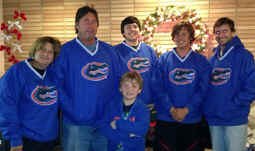 |
Zelnar
Family, from left to right Lynelle, Mike, Zach, Levi,
David & Bryson (in front) Note: Lynelle has 3 step
sons, ages, 18, 21 & 25. Son Bryson celebrated his
9th birthday on December 3, 2013. |
This
year on July 12th, Forgotten Soldiers Outreach opened a new
Thrift Store at 3032 Jog Road in Buttonwood Plaza, Greenacres.
They had outgrown their former one in the same shopping
center. And now, they are running out of room again. They are
looking for another angel who can provide a store front with
5,000-6,000 sq. ft.
Their
Thrift Store brings FSO full circle by helping vets on the
home front. They are still sending packages to all world
theaters: Kosovo, Korea, Africa, Somalia, Japan as well as
Iraq and Afghanistan ... wherever we have troops deployed. FSO
has aligned with FAITH*HOPE*LOVE /Stand Down House, VA HUD-VASH
Program and other organizations in assisting veterans and
homeless vets through the Thrift Store as they transition back
to life here at home with vouchers for furniture and other
items. All veterans, old and young, receive 50% OFF every day
at the FSO Thrift Store.
They
are open 6 days a week, Monday through Saturday from 10AM to
7PM. They feature furniture, household decor, vintage items,
clothing, books, knickknacks and more. They offer free pickup
of your donated items, also accepting whole estates.
For
more information, please call them at (561) 969-2222.
More
about Thrift Store opening: Condo News Online - Veterans News |
|
Condo
News is introducing a new feature for readers’
participation
...
Condo Art Corner.
We
invite you to submit a photo of art that you have
created --
painting,
sculpture, drawing, artistic photo, carving,
etc.
Please
submit your item as a .jpg with 300ppi
resolution
by
email to: info@condonewsonline.com.
In
the subject line please type "Art
Corner."
Include
a title for your item and the medium you used.
Submissions
will appear first in our print paper
and
then on our website.
Amateur
artists only, please.
|
|
"Soccer
Anyone"
By
Nancy Lee
Willow
Bend, Lake Worth, FL
Acrylics
2013 |
 |
|
|
REFLECTIONS
OF MOTHER
A
series by Betty Thomas, Condo News Publisher |
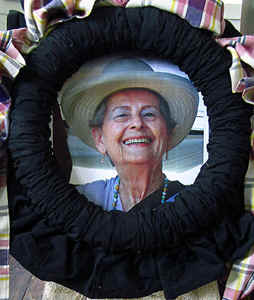 |
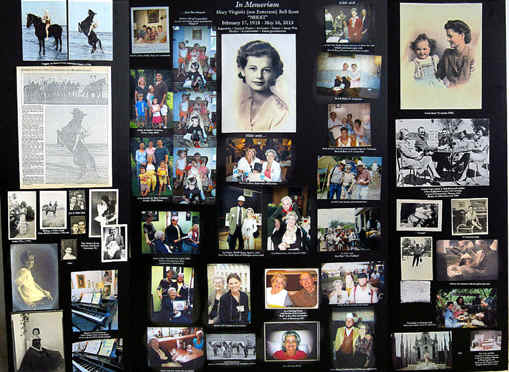
Mary
Virginia Patterson Bell Scott
2/17/1918
- 5/16/2013
Mother's
Memorial Wreath displayed at a memorial service conducted by
the Order of Confederate Rose members Becki Powell and Kathy
Clark with prayers led by Charlie Dennis, in the church at the
Yesteryear Village on Sunday, May 26, 2013. The photo was
taken at the Yesteryear Village in "better days".
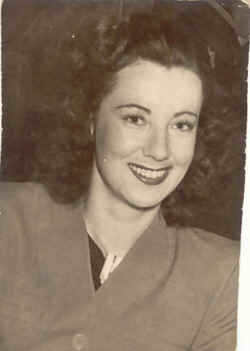
Mother was a member of OCR. The wreath was made by Becki
Powell. |
|
May
29, 2013
PART
1 of 2
It’s
new — it’s raw — and it takes my mind on an excursion
into the life of the woman who was my mother ... "my
beautiful mommy" ... as I called her when I was a
toddler, and back into my life as her daughter, her only
child.
Mother
passed away two weeks ago. Even though she was 95 years old
and severely affected by several strokes, it’s a loss that
leaves such a void. There is sadness that she is gone and
relief that her long suffering is finally over and she is in a
better place. I have been reflecting on my life with mother
from my childhood to the present and on her life as well from
her childhood. I miss the closeness we had, the places we
would go together. I remember calling her from Maryland after
she moved to Florida (Ft. Lauderdale) just to ask her help
with one of her recipes or how to put a new tape in her IBM
Selectric typewriter (she worked in our family business in
Maryland). It wasn’t too long before I, too, came to Florida
-- and to the Condo News. Then, after her husband died,
mother came to Palm Beach County (Greenacres) and we could
"buddy up" again.
We
would take trips to visit her grandsons (my children) in
Virginia and Pennsylvania when each of her great grandchildren
were born. She loved to decorate her condo and go to Tuesday
Morning and Big Lots. How excited she was when Carpet Mills
Direct tiled the floors in the condo. We went to movies
together (we roared with laughter all through "My Big Fat
Greek Wedding" -- my ex husband is Greek) and she came
with me to the Yesteryear Village during the South Florida
Fair and to the dinners twice a year that the Veterans of the
Battle of the Bulge held. When she moved into her condo at La
Pinata, I suggested she take her camera when she went to the
clubhouse and take pictures at the parties. She did and found
that she quickly made friends. I loved putting pictures that
my mother took in the Condo News with "photo by
Nikki Scott." She enjoyed her condo and friends for just
6 years. Then it happened.
Mother
came to live with me in November 2006 after suffering a
stroke. She could use a walker but her balance was very bad.
She could not take a step or stand without holding onto
something. She spent a month in rehab before coming to my home
for good and leaving her "nest" behind. Fortunately,
I can work from home, so there was no problem, and I could be
there for her.
Over
the next 6½ years, a series of strokes gradually caused more
and more weakness, "transfers" became increasingly
difficult until the last one in November 2012 left her unable
to raise herself up even from the lift chair. The man in my
life, Jimmy, stepped up to assist in getting her from one
place to the other (bed to wheel chair, to lift chair, etc.)
She became unable to feed herself and her vision seemed to
decline more rapidly.
Then
in March, her swallowing became more difficult and finally
near the end of April, she could only get a few spoonfuls of
soft food down and, again, I had her admitted to the hospital
(JFK) on a Friday. By Thursday, I had her transferred to
Hospice of Palm Beach County there in the hospital. It was
determined over the weekend that she was stabilized and was
sent home under Hospice Home Care. But, she passed away 2½
days later on May 16 — seemly, she’d had enough.
While
in Hospice, on Mother’s Day, the priest came to her room and
gave her the Last Rites, also known as the Sacrament for the
Healing of the Sick. Mother was aware of what was going on.
She answered each prayer the priest said over her with a
sweet, "Thank you."
Mother’s
strokes were caused by Atrial Fibrillation. She apparently had
had several "mini strokes" before the one 6½ years
ago. She had what is called vascular dementia which worsened,
along with all her other symptoms, with each stroke.
Incontinence was the third symptom.
It’s
called Normal Pressure Hydrocephalus. The ventricles in her
brain filled up with too much fluid putting pressure on the
brain. She was too old to put in a shunt which might have
relieved her symptoms. NPH causes a triad of symptoms: a
widened gate and a sense that the feet are glued to the floor,
dementia and incontinence. She always had the sense that she
was falling backwards.
The
void is there, and my reflections of her constant. I will
share some of them with our dear readers in a coming issue.
|
|
September
4, 2013
Part
2 of 2
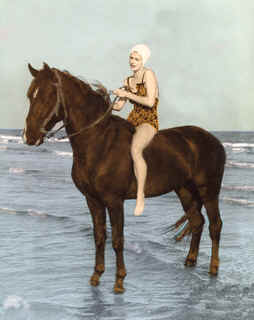
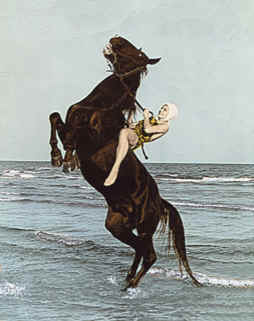
Photos
above were taken for an article in the local newspaper in
Galveston, Texas, where my mother grew up. The photo on the
right was run with the article. Mother's years in Galveston
(from infancy to her 20s) were spent behind a piano keyboard
(she became a concert pianist) until a hand injury
necessitated a hiatus from music. Her favorite pass time was
spent on Galveston beach astride General Jack, the horse only
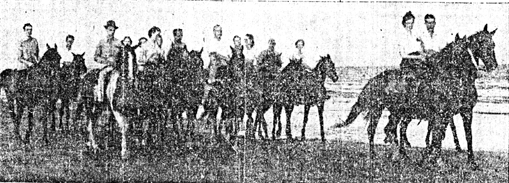
she could ride. Below is another picture run with the article
showing folks riding horses along the beach. See the story
below which appeared in the newspaper in 1936 ...
(Photos
above were colorized by Jimmy Shirley) |
|
Circa
1936
Horseback
Riding Popular Diversion on Galveston Beaches
"For
years horseback riding on east and west beaches has been a
favorite diversion of Galvestonians, and visitors here who are
fond of horses have been quick to follow the sport.
"On
almost any clear day bathers may see groups of riders, often
as many as a dozen, either exploring the sand dunes back from
the beach or cantering along the edge of the water. Many
Galvestonians ride daily as their means of recreation. Others
are less regular but none the less enthusiastic.
"Some
of them own their horses and keep them stabled on the beach.
Others rent the animals from the stables, and one may be sure
that the mounts soon become known by their dispositions. Men
and older boys naturally prefer horses with spirit and
fast-gaited, but most women and younger boys and girls, of
course, choose animals of a more docile nature.
"The
horses themselves often learn their riders, so regular are
some of them about riding. Most Galvestonians who ride equip
themselves with the proper clothes and boots, and favorite
times for riding are early morning, late afternoon, Sunday,
and especially cool days during the week.
"The
gulf breeze and smooth white beach make riding only an added
pleasure to being near the sea. Many prefer riding back from
the water. Others prefer to walk their animals near the water.
"In
the picture at right, Miss Virginia Patterson, astride General
Jack, is putting her mount through his tricks. Almost every
day, clad in a bathing suit and riding bareback, she takes him
into the surf, which he enjoys as much as she does.
"For
stimulating relaxation, physicians say nothing is so healthful
as horseback riding. Many Galvestonians ride awhile and then
cool off after their exercise by taking a dip in the surf.
They recommend this to anyone in need of a tonic for
indolence."
Interestingly,
back in Oct. 2011, I saw an article in the Post with a
photo similar to the one at the beginning of this article of
horseback riders on Hutchinson Island with Beach Tours. The
caption read "...horseback riding is good therapy for
anyone who loves the romance and beauty of a horse." I
guess what was good once is still good.
*** |
|
|
Have you written
an essay you would like printed in the Condo News?
The
Condo News reserves the right to edit for space and to reject any essay for subject
matter. Sorry, we cannot accept poems.
Email
your item to info@condonewsonline.com
For further information call (561)
471-0329
|

Home
Food, Fun & Entertainment
| Decorating Concepts |
Brag Book | Yesteryear Village
The
Clubhouse Gallery | Gardening
| Out & About | Fit After Fifty
| Sports
CAM
Corner | Local News
| Veterans News
| Gulf Wars
Ask
the Lawyer
Community Association Counselor
| Condos of S. Ocean Blvd., PB
Essays
| Letters to the Editor &
Opinion Articles
Classified Ads | Real Estate |
Display Ads
Ad Form | Advertising Rates | Contact Us
Visit Netword2000
Web Design by LD&D
|
 
|