|
Opinion
• Editorials • Letters to the Editor
Contributors:
• Jimmy Shirley,
Commentaries
•
Editorial - Jimmy Shirley and Betty Thomas
•
Readers Respond ~ Letters to the Editor
|
As
I See It ...
Commentary
by Jimmy Shirley
|
 |
|
|
(10-22-20)
Constitution
Day, Part 3
The
States, as the 4th Branch of Government
In
practical terms, the States created the national government. And at
first, the governmental form of the United States was as a
Confederacy.
Properly
entitled The Articles of Confederation and Perpetual Union (AoC&PU),
it was an agreement among the 13 original Sates of the United States
of America that served as its first constitution. The Articles of
Confederation came into force on March 1, 1781, after being ratified
by all 13 states. It is a fact that many Americans referred to the
United States as "our confederacy" all the way up to the
War Between The States.
Later,
in 1787, it was the States that decided to reform the AoC&PU and
met in Philadelphia to do just that. As had been their mission as
per their respective States' directives. But when they got there,
they closed the doors and proceeded in secret to form something
entirely else. A new form of governance, a Republic.
And
as these States went about doing this, they were ever guardful of
their respective States' rights and sovereignty. Consider the
following quotes taken from the book entitled, SECRET PROCEEDINGS
AND DEBATES of the CONSTITUTIONAL CONVENTION 1787, first published
in 1838, republished in 1986 by Omni Publications.
"I
will never consent to destroy State governments, and will ever be as
careful to preserve the one as the other. — George Mason
"I
know that government must be supported; and, if the one was
incompatible with the other, I would support the State government at
the expience of the Union." — Luther Martin
"The
general government is, therefore, intended only to protect and guard
the rights of the States, as States... The only necessary check in a
general government ought to be a restraint to prevent its absorbing
the powers of the State governments." — Luther Martin
And
one more from the secret convention.
"Let
the constitution we are about forming be considered as a commission
under which the general government shall act, and as such it will be
the guardian of the State rights". — Rufus King
So
given the U.S. Constitution guarantees each State a republican form
of government, Article IV, Section 4, we are a Republic of
Republics. And as such, according to the book "A VIEW OF THE
CONSTITUTION OF THE UNITED STATES OF AMERICA", by William Rawle,
LL.D, originally published in 1829, reprinted in 1998 by Crown
Rights Book Publishing, the States have the right of last resort
to secede, so long as they retain their republican character as
their form of government. For if they decide to shed that republican
character, and thus violate the Constitution as per above, then they
have not the right of secession.
The
extensions of that right are such things as what is and is not
Constitutional as it affects their respective States. And as an
aside: I realized not all that long ago it helps people to use
sports analogies as a way to understand stuff so here goes. As all
play on the field must conform to the rulebook, in whatever sport it
is, so it is with the Constitution. Just think of it as the
rulebook, all laws must conform to the rulebook. And if/when someone
thinks a law does not, they appeal to the referees, the judges. And
in the course of time, the judges rule on the play/law. Easy, right?
So
guardful were the States of their rights, Massachusetts, North
Carolina, Maryland, South Carolina, amongst the others, declared in
their ratifying statements that that it be explicitly declared, that
all powers not expressly delegated by the aforesaid Constitution are
reserved to the several states, to be by them exercised, and/or
words to this affect. |
|
(9-24-20)
Constitution
Day, Part 2
The
Electorial College |
|
For
quite some while now, a large, uninformed segment of the American
nation has been hammering for the elimination of the Electoral
College. It has been described as archaic, no longer needed and
recommended the National Popular Vote (NPV) in the selection of
the President of the United States. They think ONLY "We the
people..." should be trusted to make this momentous decision.
I have viewed some many videos of ordinary Americans being
"street interviewed" about their knowledge and
comprehension of American history, American civics, even American
geography. Approximately 9 of 10 persons could not answer the most
simple questions. So simple, it was like asking what is 10 + 1 and
spotting them 10. They just did not know. And those that think the
President should be chosen by only the people must also include
people so stupid as this? They know far more about the
Kardashian's, Dancing With The Stars, The Voice... useless trivia
like this than they know about the separation of powers. Most
people have no idea at all of the four branches of governance, i.e
- Legislative, Executive, Judicial, STATES.
And
so I disagree!. Because if the average American was fully educated
in their civic duties and responsibilities, as well as the
pertinent issues at hand, and was concerned and aware, I might
would agree. But they aren’t, they don’t, so I don’t agree.
It
is the opinion of this writer that the vast majority of Americans
have no clue at all about the pros and cons of some of the issues,
never mind those that affect the whole country. Most Americans
know a whole lot of nothing about the real things, like who their
State and national representatives are and how they vote on the
proposed laws.
As
it is now, most, if not all the States have winner take all laws
regarding their respective State’s Electoral votes. Given the
general state of ignorance amongst the American people, I think
the Presidential elections should be removed from the people and
placed back in the hands of the Electoral College ONLY. And they
to be selected by the respective State’s legislators.
Besides
which, the popular vote for the President would place the election
in the hands of a very few geographical places. For example,
nearly 1/4th of the population of Illinois lives in the city of
Chicago (some 3,000,000). And the population of Chicago is greater
than 20 States such as Nevada (2,700,551), Kansas (2,915,918) and
Mississippi (2,967,297). New York City has a population 8.1
million compared to the State of Michigan’s 9.8 million people.
If a NPV scheme were adopted, where do you think Presidential
candidates will spend the bulk of their time, money and energy? Do
the best interests of the whole country really want a NPV? This
writer says it serves NOT the best interest of the whole U.S. of
A.
Moreover,
this writer favors a written civics test be required to pass afore
anyone register to vote. And every voter, period, be required to
pass it every eight to 12 years. Don’t we have to pass a written
drivers test, some cases also a test whilst driving the car? And
it makes good sense, dontchathink? |
|
(9-9-20)
Constitution
Day, Part 1 |
|
September17th
is Constitution Day. What does that even mean and why should it be
a thing? You ask. So did I when I was given this assignment. The
short answer? It is the day in 1787 when the convention in
Philadelphia completed the work of revamping Confederacy style of
government the United States started out with. And just what was
it replaced with? A democracy I bet you all think. And then you'd
be thinking wrong. This anecdotal exchange has withstood the test
of time and is a fair look at just what form of government
replaced the olde Confederation, to wit: "A lady asked Dr.
(Benjamin) Franklin, 'Well Doctor, what have we got a republic or
a monarchy?' A republic, replied the Doctor, if you can keep
it." This, according to the notes of James McHenry, a
Maryland delegate to the Constitutional Convention.
In
McHenry’s original notes, he included the footnote, "The
lady here alluded to was Mrs. Powel of Philad[elphi]a." Mrs.
Powel is Elizabeth Willing Powel, a prominent society figure and
the wife of Philadelphia Mayor Samuel Powel. Like Franklin, Powel
was known for her wit and knowledge. She often hosted convention
delegates and their wives in her home, and later became a close
friend of George and Martha Washington, who spent most of
Washington’s presidency in the temporary capital of
Philadelphia.
So,
have we kept it?
There’s
an extended version of "A republic, if you can keep it,"
too. In McHenry’s 1803 account, Powel immediately shoots back,
"And why not keep it?" Franklin responds, "Because
the people, on tasting the dish, are always disposed to eat more
of it than does them good."
Below,
is a VERY brief descript of the beginning of the Convention:
May
25, 1787, freshly spread dirt covered the cobblestone street in
front of the Pennsylvania State House, protecting the men inside
from the sound of passing carriages and carts. Guards stood at the
entrances to ensure that the curious were kept at a distance.
Robert Morris of Pennsylvania, the "financier" of the
Revolution, opened the proceedings with a nomination--Gen. George
Washington for the presidency of the Constitutional Convention.
The vote was unanimous. With characteristic ceremonial modesty,
the general expressed his embarrassment at his lack of
qualifications to preside over such an august body and apologized
for any errors into which he might fall in the course of its
deliberations.
And
so on on 26 July 1788, the former colonies, now States of Virginia
and New York, collectively became the 9th State needed to ratify
the new Constitution, required for it to come into action. From an
idea, to a reality. |
|
(8-26-20)
American
Comparisons |
|
Why
do so many Americans like to compare the United States to other
countries of the world? Especially during times of crises.
"Why cant we be more like Sweden? Denmark? New Zealand?
Germany?"
Why
in the world would anyone seriously contemplate that? Why have so
many Americans come to want a top down rule over us, in the stead
of a republic whereby we choose, not our rulers, but our
representatives to legislate on our behalf and for our benefit?
Leastwise, this is how it is suppose to be, how it was meant to
be.
All
other countries in the world have a centuries long, millennium
long even, history of kings, queens, emperors, tyrants, dictators.
Why would even one single American want this? Let alone millions
and millions?
During
this Wuhan virus flu pandemic, I occasionally see newspaper
articles (Yes, we get the hard copy print version of a daily
newspaper still, in this internet era) about how much better other
countries around the world are faring than is the United States.
And this is due to, in part, their people being generationally
conditioned to being TOLD what to do by their country's leader,
whatever his title.
Throughout
the first 150 years of the existence of this country, beginning in
1783, it was the State governors that people looked to for
leadership. It was the State that held sway over life within their
borders, though still subject to the powers of the national
government that the States had delegated to it.
This
writer began noticing more and more, via LTEs (Letters To the
Editor) in the several local newspapers beginning in the late ‘70s
to early ‘80s whereby people were noting non-existent problems
they wanted fixed by the national government, when they should
have been addressing these concerns to their local city of county
government. It was like they never had a neutral civics class in
their school days.
How
would y’all like it if, whoever the President is, ordered
(dictated?) that EVERYONE MUST wear a facemask?
Is
this really what all Americans want? No, of course not. But a
large enough people do, and that is scary. Why?
Because
our republic is and always has been fragile. Benjamin Franklin was
asked, after the Constitutional Convention ended, what kind of
government had they "given" us. He replied, "A
republic, if you can keep it." This according to tradition.
The reality is, the United States in no way of governance
resembles the republican ideals bequeathed us by the Founding
Fathers. That concept, whereby the States were the final arbiters
of just what is and what is not Constitutional, died in 1865. Ever
since then, the national government has become its own arbiter of
what it can, and can not do.
So
why continue to compare us unfavorably to top-down ruled
countries? Beware of what ye ask for. Ye might just get it. |
|
(8-2-17)
American
Patriotism |
|
I
joined Youfit, a then newish concept for a workout gym, about
seven years ago. No yearly contracts, just pay monthly. It is
located at the shopping center of Military Trail and Cresthaven
Boulevard. I mostly do a cardio workout on the treadmill, then
just a little bit on weights.
About
two weeks ago, I noticed the McDonalds, located closest to the
Trail as Youfit is at the rear of the shopping center, had the
federal flag flying at half staff. Which I thought was odd as I
had not observed any others anywhere else so displayed. But I
thought, "Hhmmmm." And let it go.
But
as the days went on, the flag remained at half staff. Now, there
are five special days where the flags should be lowered to half
staff as a matter of routine. Also, the Governors of the several
States and the President of these United States can order flags at
half staff. But no one else, according to Flag Etiquette.
As
the days went on, I thought surely a veteran, an American patriot
would stop by to investigate why this was. It seemed to me
something was amiss. One day about a week ago, I noticed a female
McDonalds employee (she was so dressed) walking by, so I hailed
her and asked. Turns out, she not only knew not, she had zero clue
about flag etiquette at all. She wouldn’t have known from full
staff to laying on the ground in the dirt. But did promise to
mention it to her manager. Saw her again the next day and asked.
She said "he would take care of it." That was Tuesday.
By
Thursday, nothing had changed. So, I took it upon myself to do
something about it. I walked over to the flag pole, saw the roping
was where I could, so I hauled the flag down, took it inside and
asked to speak to the manager. Upon laying the flag on the counter
giving it back to him, I told him in not so many terms, LOUDLY,
that it was disrespectful to display the flag thusly, that he had
no right, nor authority to display it such, that neither did the
Corporation. By way of trying to avoid making a scene, he took the
flag into the back, telling me he would take care of it.
Thing
is, only "south-of-the-border-people" were seated there.
They wouldn’t care either way. NO true Americans. So I can help
but wonder why of all the thousands of people who travel by the
restaurant every day, plus those traveling along Cresthaven, no
one bothered, or no one noticed? Why was I the only one? I’m not
even a veteran and I have my own issues regarding this country.
You
see, I have noticed a gradual decline, loss of American liberty in
my lifetime. I have noticed the powers that be deliberately infuse
millions and millions of illegal non-Americans into our society,
then declare us anti-American if we don’t just welcome them all
with open arms, saying if we don’t, it’s not who we are as a
country. Never mind loads of these people hold ancient grudges
against us, if not just hate us.
Then
there are the leftist college professors who have infested the
institutes of higher learning. They are producing large numbers of
young men and women who not only hate this country, but are
ignorant of the rest of the history and ignorant of civics. Ask
most millennials about American civics or history, and they have
zero clue. Ask about useless entertainment/sports stuff, they
almost instantly know the answers.
With
the selection of Donald Trump as President, the leftists began
throwing the most massive temper tantrum I have ever seen. But
only befitting of little children eight and under. Love of country
says, "I disagree with you, but I’ll fight to the death for
your right to say it ‘NOT AT ALL’ America! Love it or leave
it!" To put THAT in perspective, think of the varying
governmental dictatorships since 1900. Between Communist China and
Communist Russia, they murdered close to 100 millions of their own
people in the 20th century through purges of those disagreeing
with party policy/country.
Now
comes a renewed hatred of American history from these
indoctrinated millennials. It has infected growing number of city,
county, State leaders. It is the removal of monuments to the
Confederate States of America, the renaming of anything bearing
the names of Confederate heroes.
A
few points to consider regarding the Confederate-American history.
From Thomas Jefferson – "If any State in the union will
declare that it prefers separation with the 1st alternative, to a
continuance in union without it, I have no hesitation in saying
"Let us separate." In his first inaugural address, he
said this, "If there be any among us who would wish to
dissolve this Union, or to change its republican form, let them
stand undisturbed as monuments to the safety with which error of
opinion may be tolerated where reason is left to combat it."
And
this from the classic prophetic book "1984" - "Do
you, realize that the past, starting from yesterday, has been
actually abolished? If it survives anywhere, it’s in a few solid
objects with no words attached to them, like that lump of glass
there. Already we know almost literally nothing about the
Revolution and the years before the Revolution. Every record has
been destroyed or falsified, every book has been rewritten, every
picture has been repainted, every statue and street and building
has been renamed, every date has been altered. And that process is
continuing day by day and minute by minute. History has stopped.
Nothing exists except an endless present in which the Party is
always right. I know, of course, that the past is
falsified, but it would never be possible for me to prove it, even
when I did the falsification myself: After the thing is done, no
evidence ever remains. The only evidence is inside my own mind,
and I don’t know with any certainty that any other human being
shares my memories. Just in that one instance, in my whole life, I
did possess actual concrete evidence after the event—years
after it."
Which
brings me to this. I don’t recognize this country. It is so very
different than the one I grew up in, spent my adult life in. It
didn’t happen all at once, but the realization did. I was in a
Walgreens about 15 years ago and I was the only White American
shopping in the store. No one was speaking English, even the
employees. It was the first time I had ever felt like a stranger
in my own country. And that sensation has only increased in
quantity since. I am not opposed to legal, controlled immigration,
but I am against opening the floodgates. As I am against erasing
history. What IS anti-American, what IS against "who we
are" is being in favor of removing the monuments and the
renaming, being in favor of unfettered immigration. Even for a
legal immigrant to come here, then complain about our ways, our
customs, refusing to become a real American, not just a legalized
paper one, THEN I can honestly say, "you don’t like it
here, leave! Go back where you come from." You want to live
here, fine, become one of us, embrace us, learn to speak English
with a Southern accent. Then you’ll be one of us.
God
Bless Dixie and God Bless the United States of America! |
|
(9-14-16)
The
Fourth Branch of the U.S. Government:
The
States |
|
In
the last issue of the Condo News in August, Anne Gannon,
the Constitutional Tax Collector, offered a "Cliff’s
note" briefing of the Constitution of the United States of
America (COTUSA). This brief was incomplete. For, unbeknownst to
the vast majority of Americans, there is a FOURTH branch of
government, one that was established to be the final arbiter of
national government power. The States themselves. To properly
complete her quote, it should have read, "The Constitution
splits power among the four branches of government." To
explain, power was set up and split among the legislative,
executive, judicial and the States, who themselves consist of
those three of four branches.
Because,
the last I knew, the 9th and 10th Amendments have not been
repealed, thus are still in force. To enunciate, the 9th Amendment
reads thusly, "The enumeration in the Constitution, of
certain rights, shall not be construed to deny or disparage others
retained by the people." and the 10th reads as well,
"The powers not delegated to the United States by the
Constitution, nor prohibited by it to the States, are reserved to
the States respectively, or to the people." The Fourth Branch
of "checks and balances."
Additionally,
the article seems to imply that, upon being signed by those who
stayed at the Constitutional Convention to the end (some left in
protest and 39 of the original 55 delegates ended up signing it),
it subsequently went into force. HARDLY!
Now
it was up to the several States, in their sovereign and
independent capacity, to ratify it, or in other words, sign up and
join in. Those independent "nation-States" who would not
join would NOT be forced to at gunpoint. For as the Constitution
reads in Article VII, para. 1, "The ratification of the
conventions of nine states, shall be sufficient for the
establishment of this Constitution between the states so ratifying
the same."
That
number 9 threshold was not reached until 21 June 1788, New
Hampshire being the one, although ratification barely squeaked by,
with just 55% of the vote in favor.
Just
to ""LIST"" the vote totals of the several
States, done in convention, shows this new government to replace
the Confederacy that was formed under the Articles of
Confederation was hardly popular amongst all of the States.
Delaware, 7 December 1787, 30 to 0 (100%); Pennsylvania, 12
December 1787, 46 to 23 (67%); New Jersey, 18 December 1787, 38 to
0 (100%); Georgia, 2 January 1788, 26 to 0 (100%); Connecticut, 9
January 1788, 128 to 40 (76%); Massachusetts, 6 February 1788, 187
to 168 (52%); Maryland, 28 April 1788, 63 to 11 (85%); South
Carolina, 23 May 1788, 149 to 73 (67%); New Hampshire, 21 June
1788, 57 to 47 (55%); Virginia, 25 June 1788, 89 to 79, (53%); New
York, 26 July 1788, 30 to 27 (53%); North Carolina, 21 November
1789, 194 to 77 (72%); Rhode Island, 29 May 1790, 34 to 32 (52%).
In
all, 1071 of the total number of delegates at the several States’
Conventions favored this new over the old government, 577 opposed,
a 65% majority. So, simply being signed by those at the
Constitutional Convention was NOT required for the COTUSA to go
into effect. It required a 3/4ths majority of the States and was
ONLY in force amongst those, NOT any of the others.
Forcing
the States at gunpoint would not come along, would not happen
until 1865. |
|
(5-25-16)
Memorial
Day ? Veterans Day?
Is
There No Difference? |
|
Every
year, this time of the year, this writer gets to pet a peeve he has
developed in recent years. For some reason, and he has no real clue
just how this got started, Americans think it a matter of course
that Memorial Day is a day to CELEBRATE, have a cookout, party,
drink spirits and have a generally raucous time, AND thank an
American military veteran for his/her service.
While
these activities are OK at their time and in and of themselves, they
are misguided for this day, in the opinion of this writer. At least
until the proper way to observe Memorial Day has been performed. And
that is by attending some certain commemoration exercises at a
graveyard where American military veterans are thusly interred.
Sadly, and telling as it is, most of these Americans never even go
to a graveyard, let alone once a year. For them, it is party time.
"Time to PAR-TAY!!!" Never mind those brave men and women
buried who died in battle, ultimately protecting our American way of
life, even if it seems that way of life appears to be slowly
slipping away. Forget about all those others who at one time served
in the armed forces in diversity of ways that ultimately kept the
front line strong, then left the service and lived out their lives
either anonymously of somehow, someway in the public eye. YEAH, let’s
just make this day all about what I want to do and make no mention
at all, either out loud or in hushed whispers, those Americans lying
in graves. SMDH. (If the readers don’t know what this means, find
out.)
Veterans
Day, on the other hand, IS THE day to do all those things above.
Because it is the day set aside to not just honor but to celebrate
the living veteran. Do this while they yet live so they hear it, see
it, experience it, and FEEL appreciated. KNOW they are appreciated.
Shake
their hand, tell them thanks, buy them a meal at a restaurant, share
drinks with them, but not excessively. Cheer them at the parades, go
to the parades. And that is another peeve I pet. THESE parades are
not about the marching bands and the diverse civic organizations,
they are meant to be for the living veterans. What the bands ARE
meant to do is to make a joyful noise unto the veterans, not for
themselves to outshine the vet.
Teach
the difference to your children and grandchildren. Because if we do,
we can begin to correct the course the country has been on far too
long back to the appropriate way to observe these two very different
holidays. One for the living, one for the deceased. |
|
(5-27-15)
The
Electoral College Revisited
|
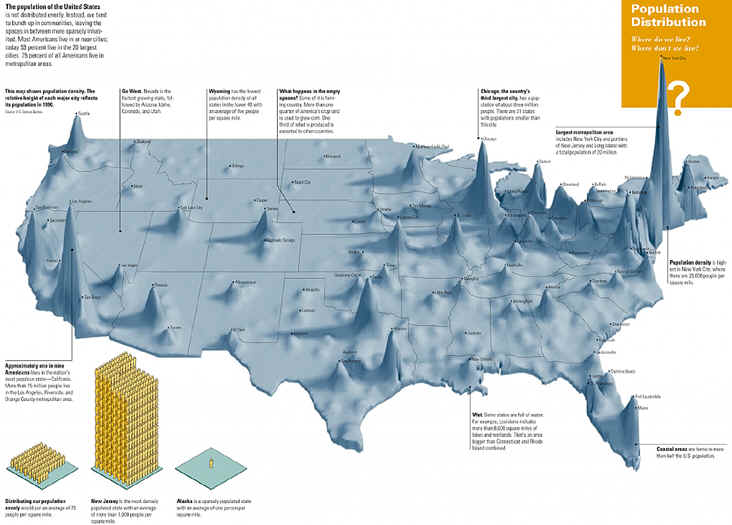
| The map
graphic above, from the website Motor City Times, depicts the
population density areas in the U.S. The peaks represent the most populous
areas. The block graphic represents the U.S population per square
mile if it were evenly distributed (left) with 75 persons per square
mile; and (center) New Jersey is the most densely populated at more
than 1,000 persons per square mile (average); and Alaska with an
average of 1 person per square mile. The highest peaks represent
NY/NJ, Chicago, Coastal areas of SE Florida; and Los Angeles area in
SW California.
|
|
A
recent Letter To the Editor (LTE) in the Palm Beach Post
suggested a new Constitutional Convention to rewrite the
Constitution of these United States of America. In this LTE, the
writer had a few of his own changes to recommend. One was the
elimination of the Electoral College. He described it as archaic, no
longer needed and recommended the National Popular Vote (NPV) in the
selection of the President of the United States. I SO disagree with
him. Because if the average American was fully educated in their
civic duties and responsibilities, as well as the pertinent issues
at hand, and was concerned and aware, I might would agree with him.
But they aren’t, they don’t, and I don’t agree with him.
In
fact, it is the opinion of this writer that the vast majority of
Americans have no clue at all about the pros and cons of some of the
issues, never mind those that affect the whole country. To this
writer, most Americans know a whole lot more about frivolous,
inconsequential crap like entertainment celebrities than the real
things like who their State and national representatives are and how
they vote on the proposed laws.
As
it is now, most, if not all the States have winner take all laws
regarding their respective State’s Electoral votes. Given the
general state of ignorance amongst the American people, I think the
Presidential elections should be removed from the people and placed
back in the hands of the Electoral College ONLY. And they to be
selected by the respective State’s legislators.
Besides
which, the popular vote for the President would place the election
in the hands of a very few geographical places. For example, nearly
1/4th of the population of Illinois lives in the city of Chicago
(some 3,000,000). And the population of Chicago is greater than 20
States such as Nevada (2,700,551), Kansas (2,915,918) and
Mississippi (2,967,297). New York City has a population 8.1 million
compared to the State of Michigan’s 9.8 million people. If a NPV
scheme were adopted, where do you think Presidential candidates will
spend the bulk of their time, money and energy? Look at the map and
the reader will see where. Do the best interests of the whole
country really want a NPV? This writer says it serves NOT the best
interest of the whole U.S. of A.
|
|
(5-13-15)
A
Brief Sketch of the 9th and 10th Amendments
There
are loads of Americans who have no regard at all for the several
States. Most of them even have no clue about the history of their
State’s of residence. Such as, they would not recognize their
State flags.
Now
comes Rep. Lois Frankel (D-Fla) who wants to nullify the 9th and
10th Amendments to the U.S. Constitution. To wit; national
legislation that imposes, yet again, national authority, of which it
should have none, over the States regarding the murder of unborn
children. Only now, in recent times, it is referred to as
"women’s health" or "healthcare" in general.
Make
no mistake. Abortion equals murder, for once the female egg has been
fertilized, it shall become a living, breathing person. Murder of an
unborn is hardly different than the murder of a newborn. That is not
an opinion, that is a fact.
Now,
one might say "I am a man, I have no say in the matter."
To which I reply as this is a moral matter, everyone has a say in
the matter. AND, as this genocide is funded by my tax dollars gives
me another right to speak. As of 2013, 55,772,015 unborn Americans
have been slaughtered. This is more than 1.3 million per year, which
exceeds the rate of the Holocaust. Thus it is genocide. And I have a
right to speak. And thus, it is the State’s Right to protect it’s
citizens Right to Life, Liberty and the Pursuit of Happiness, as
spelled out in one of the Founding documents, the Declaration of
Independence. |
|
(4-29-15)
The
Everglades Trust group ad unfairly blames "Big Sugar"
for Everglades’ woes
I
am appalled by the attempt of The Everglades Trust group to make
smoke look like water vapor. The analogy is correct. Because if
you show someone smoke from burning wood and tell them it is
water, if they don’t know any better, they will believe you.
Thus
it is with their egregiously misleading advertisement in the Palm
Beach Post on page A9, Tuesday 21 April 2015. To read it
over, one believes that "Big Sugar" is directly
responsible for the damming of Lake Okeechobee, leading to the
draining of the "River of Grass" along with the
Kissimmee River Valley area. And one would be wrong.
Back
in 1928, a major hurricane caused a flood immediately south of
the lake, which killed upwards of 3,000 people. This prompted
the national government, and the Army Corps of Engineers, to
plan and build the Dike now encircling the Big Lake. "Big
Sugar" did not exist when they started the Dike. Mostly,
what land was available was used for small Mom and Pop farms.
NOT big corp. farms like this day. Notwithstanding there were
sugar growers back then. Even the United States Sugar
Corporation which was founded on 28 April 1931 by automotive
pioneer, industrialist, and philanthropist Charles Stewart Mott
who acquired the lands, mill, and other assets from the bankrupt
Southern Sugar Company and turned it into the United States
Sugar Corporation.
Moreover,
vegetable farming and cattle ranching were the prevailing land
users even as recently as the late ‘60s, to early ‘70s.
Being born and reared there, I well recollect seeing the
windmills dotting the landscape which powered water troughs to
water the cattle. Belle Glade once even had their own livestock
market. In fact, in 1940 U.S. Sugar started one of the first
large cattle ranches in the Glades. The King Ranch, south of
Belle Glade, had 40,000 cattle at one time.
I
well recollect money flowing in the Glades communities
throughout the year from vegetable farms. Whichever crop was in
season provided year round employment to many of the pickers and
pullers of the crops. In fact, it was with the rise of Communism
and Fidel Castro in Cuba, along with the embargo, which led to
the sugar company’s purchase of more and more land by which to
grow ever more sugar cane. Due to sugar subsidies, then price
controls, more and more small farmers began either selling their
land to the sugar growers, or changing over from vegetables, and
the uncertainty of the markets, to sugar cane, and the certainty
of profits.
Don’t
misunderstand. Somehow, someway, the water problems that exist
including but not limited to the polluted water discharges from
Lake Okeechobee need to be addressed. The correct way to get
this message across is by sticking to the facts. Thus insuring
public integrity. By using gross distortions of the historical
record, your own goals fall into suspicion.
For
example, Lake Worth was once a fresh water lake, full of the
life fresh water has. Then came the Northerners who cut a
trench, now the Palm Beach inlet, from the ocean to the lake
which started the death knell of this once thriving lake. Then
another was cut south of there, now the Boynton inlet. It would
be much more factual to show a picture of a fresh water lake
teeming with bass, bluegill and gators, then beside it one
showing a virtual cess pool and then blaming the after picture
on Northerners. This would be much more factual than the
advertisement The Everglades Trust placed in the paper.
|
|
|
(10-15-14)
Residency
Requirements of Legislators
According
to the State of Florida’s Constitution Article III, Section 15,
Para (c) and I quote: QUALIFICATIONS. Each legislator shall be at
least twenty-one years of age, an elector and resident of the
district from which elected and shall have resided in the state
for a period of two years prior to election." Whenever you
see the words "shall be" in official legal documents,
you can take that as an absolute. NO equivocating. "...shall
be ... resident of the district from which elected AND shall have
resided in the state for a period of two years prior to
election." (Emphasis mine) This is designed to keep people
honest and to have a vested interest in their State.
Unfortunately,
there is no such residency requirement for those seeking national
office. Regarding this issue, the ONLY U.S. Constitutional
requirement for Congressional Senators and Representatives is that
they "...be an Inhabitant of that State in which he shall be
chosen." This issue is raised because the residency of Maria
Sachs has become a campaign issue. To this writer, where someone
calls home can be found on their voters registration. One can not
legitimately have more than one registered address on this list
else they can vote at several voting districts, thus vote several
times. Where our State legislators live is a valid concern for
all. Obviously, we should not have a Jacksonville resident
representing Palm Beach County at Tallahassee. Nor vice versa. It
would be an absurdity to have someone who was born, bred and lives
in the small agricultural town of Clewiston representing the large
mega-metropolis of Miami-Dade with all its diversity of cultures,
races, ethnics of peoples, right? So, it is with good reason that
our selected officials live where they claim their wish to
represent.
So,
why is this not so with the national legislators? With the
Senators, this can be understandable, given there are only two per
State. But with the Representatives? Especially within those
States that have two or more, and ESPECIALLY within those that
have far more. Florida has 27 members in the House of
Representatives. California has the most at 53 followed by Texas
at 36. We are tied with New York at third. So, does it not make
sense there should be residency requirements for those persons who
make the claim they wish to represent our concerns at the national
legislature? How can a person living in Orlando purport to
understand the concerns of us living in this county? What if all
27 of Florida’s Representatives were selected from north
Florida? From central Florida?
So,
that said, consider Alcee Hastings. He has represented Florida
from a specially gerrymandered district since 1992. Currently,
District 20 encompasses a very large swath of geography. But
looking at the map, this writer’s guess is that about 98 per
cent is uninhabited. Be that as it is, it turns out Mr. Hastings
not only does not live within district 20, he lives fairly far
from it, a good 15 miles south of its southern border. This border
runs along I-75 west to the Collier County line. South from this
line is Miramar, where Mr. Hastings lives and where the address on
his voters registration is. Now, even though legally he need not
live in the district, it seems to this writer it is good public
relations and good will to do so. Too often anymore, politicians
flout morality when they get caught with their hand in the cookie
jar by declaring "I did nothing wrong, I broke no law"
as if the law were the only measure of right and wrong. This Mr.
Hastings may well do, being a lawyer and all.
It
irks this writer that there are those who care not a whit about
where their national legislators live, so long as they get their
slice of the pie from the national treasury. For them, nothing
else matters.
Well,
IT DOES MATTER. Even though, legally speaking, the residence of
Maria Sachs is a valid issue, on principle the same questions
should be asked of Mr. Hastings and ALL those who wish to
represent their respective districts in the U.S. House of
Representatives. Remember, in theory anyway, the national
government is an agent of the several States. We are not mere
provinces, doing the bidding of a centralized authority ruling
from on high. We the States created the national government, not
the other way around. Fair is fair. If our State legislators are
legally required to live in the districts from which they are
selected, so too should the national legislators, specifically
those in the House of Representatives.
|
|
(10-1-14)
Use
DNA to Reinforce Death Penalty
In
the September 22nd issue of the Palm Beach Post, Darryl
Burton, wrongfully convicted of murder in Missouri and
exonerated in 2008 after DNA evidence proved him innocent after
24 years in prison, rants against the unjustness of the death
penalty, citing "so many wrongful convictions."
OK,
fair enough. All people of conscience who support the death
penalty want just the guilty deserving of this extreme
punishment to be executed. So, since it seems it is mostly DNA
evidence that solidly exonerates the "wrongfully
convicted", why not introduce it in the trial phase so as
to solidly convict the guilty?
In
his article, Mr. Burton says, "... executions have no place
in an imperfect system that sometimes convicts the
innocent." Well, NOW with DNA evidence, there can be no
doubt as to the proof of "who dunnit?"
Would
then those who oppose the death penalty based on the possibility
of a wrongful conviction, then support it, based on the same DNA
evidence used to exonerate? Then if so, why should the convicted
languish on Death Row for decades waiting out ridiculous appeal
after appeal. Was the murder victim given the chance to make
their appeals? For Mr. Burton talks about, "the importance
of humility in our criminal justice system." This humility
teaches us it is wrong for a man sentenced to be executed,
should outlive the families of his heinous act of cruelty. Or,
as mentioned earlier, he should languish in prison all his life.
With
this in mind, seems to me the verdict could be carried out
within five years, at most, and one year, at best. Justice
delayed is justice denied. And a just State should show its
people it hears the cry for justice from those thrown into an
early grave and from the families of the victims.
|
|
(9-3-14)
Voting
is more than American — It is a moral imperative!
Tuesday,
August 26, 2014 came and went with a whimper. Did hardly anyone
notice? In the case you wonder what that was, it was the
election day for the primary. It was the day for all Americans,
great and small, to make their ideals known through the ballot
box. Regardless of your political persuasion, your chance to
make the selection of the candidate of your choice, the issue of
your choice has come and gone.
So?
Well, according to the Palm Beach County Elections Supervisor
Susan Bucher, barely 10% of the county’s registered voters
bothered to show up to cast their vote.
With
all this talk of honoring the American veterans, especially the
passing World War II veterans, and the sacrifices they made so
that this American republic might not disappear from the face of
the Earth, that but for them, some say we might be speaking
either German or Japanese today, only 10 % of the registered
voters thought enough of their sacrifices to honor them by
voting??!!
Voting,
the way we make our voices heard in order to effect change, or
maintain the status quo, is the bedrock foundation of these
United States of America. Remember the saying we learned in
school regarding the reasons of secession from Great Britain?
"Taxation WITHOUT representation is tyranny!!"
The
sad, tragic fact is, not voting when you can is worse than just
ceding your voice to others who can round up enough votes to
support their cause. It is saying that those American soldiers
who died in battle, who were mortally wounded, died in vain. It
makes mockery of those who came back, but wounded in spirit,
bodies hacked away (like my son was) or in some way, shape,
fashion or form are unable/paralysed in life and spirit, unable
to enjoy the simplest of life’s joys such as picking up your
young child and toss them into the air and catch them, to play
catch with them, etc.
|
|
(8-6-14)
Unions
in Government
All
forms of government supposedly exist to be a servant of the
people. It does this through the goodwill of the people as well
as through certain delegated powers of authority over the
people, powers agreed to by the people for the greater good and
general protection of all. The police are a prime example of
this.
There
have to be places for all these government entities to conduct
their business, so buildings are built. There has to be someone
to help keep them organized, so more people are
"hired." As we know, there are millions of government
employees in these United States. 22 million as of March of
2012, to be exact. All these people MUST be paid, all these
buildings MUST be maintained. And this can only be accomplished
by using one of those delegated powers, the power to tax.
To
illustrate the importance government places on their power over
the people’s money, consider Al Capone finally was sent to
prison because of income tax evasion. Not for murder, extortion,
bribery, racketeering, etc.
Why
then do government unions exist? After all, being a government
employee is one of the cushiest jobs there are. According to the
2012 census report this writer is referencing, nationwide the
average monthly salary of State full time employees was $4,838.
For county and city employees, it was $4,419 per month.
Additionally, many of these States pay for their employees’
pensions separately with no help from the employees. This was so
in Florida until recently, when they were made to start
withholding a mere 3% from their paychecks to help fund the
pensions.
Additionally,
benefits ranging from paid days off to medical, dental, etc. are
generally much superior to the private sector. Why then do
government unions exist? After all, without us the American
taxpayer, government ceases to exist. What would happen if we,
in mass, decided we were going to withhold our tax money until
all governments in the States reined in their expenditures to
affordable levels? And most importantly, brought an end to
corruption and the incentives for it.
Government
employees DONT NEED unions. If anything, the American public
needs a union to protect us from the local, State and national
government’s abuses, overburdening us with heavy taxation in
order to pay for the corruption they know is going to be. Wasn’t
there a revolution back in 1776 in part because of that?
Hhhhmmmmm!!
|
|
(5-28-14)
A
Comment About Memorial Day
Memorial
Day is a day to commemorate those who have passed on. They either
died in battle, were mortally wounded and passed on a little
later, or died late in life. Either way, even if they never left
the States, even if they were never in combat, they served in the
armed forces of these United States.
So
as such, given this day is set aside for them, it is entirely
inappropriate to party. This is NOT a day of celebration. On the
contrary, it is a somber day for reflection. Reflection upon the
costs of keeping us civilians safe and as relatively free as we
are nowadays. Reflection upon those family members previously so
described. Reflection upon friends we knew, or people we only read
about, or reflection upon those many dead American servicemen we
never knew.
In
contrast, 11 November is Veterans Day. THIS is the day to
celebrate!! For in this, there are living veterans who are to be
thanked for their service.
Respect
is earned, not given, and not everyone deserves it. Courtesy is
given, not earned, and everyone deserves this.
Our
veterans have earned our respect and deserve our courtesy. They
have earned this day for most folks to halt and thank a veteran
for their service, for businesses to close this one day as a
tribute to them, for schools to close as a tribute to them, for
the school kids to spend portions of the previous week learning
about what Veterans Day is all about, for there to be parades and
picnics, and parties and celebrations. This do to honour the
living veterans so they can see it, acknowledge it, feel it, and
be proud or humbled whichever is their disposition. This do whilst
yet they live.
Then
somberly commemorate the deceased on Memorial Day.
|
|
(12-11-13)
The
"Law of the Land" Not Written in Stone
To
those who urge all Americans to just accept the so-called
"Affordable Care Act" only because, in their words,
"it is the law of the land."
Back
in 1896, racial segregation became "the law of the
land" based on the U.S. Supreme Court’s ruling. Shouldn’t
all Americans have simply accepted that based on the same
principle? If they had, it would still be "the law of the
land".
In
more modern times, the pro-traditional family law, the Defense
Of Marriage Act, is "the law of the land." Yet, there
is a small minority of people who are challenging this law at
this very time. Should they not just accept it as "the law
of the land"?
Point
is, laws can be changed upon the whims of the people and their
prevailing mood. Once this train wreck known as "obamacare"
crashes and burns, the people will demand real "change we
can agree with", to paraphrase the current White House
occupant.
|
|

|
EDITORIAL
By
Betty
Thomas and Jimmy Shirley |
|
|
|
(8-22-12)
"Write-in
Candidates" — Disfranchising the Voters, a Threat to
Democracy?
Disfranchisement
(also disenfranchisement): the revocation of the right to
vote
The
State Senate race between Mack Bernard and Jeff Clemens turned
into another one of those cliff hangers, one of those elections
where "ONE VOTE MAKES A DIFFERENCE." You know how it is,
so many people say, "Why should I vote? My vote makes no
difference." After the 2000 Presidential election one would
have thought we all would be disabused of that irresponsible
notion. In the 2012 State Senate race so mentioned, we have yet
another example of the fact that "EVERY VOTE COUNTS."
At
first glance, the District 27 State Senate race, between Democrats
Jeff Clemens and Mack Bernard, should have appeared on the
Republican ballot, but it did not. Why should it, you ask? Because
the race had no Republican challenge, it should have fallen under
the, and most importantly, I quote from the sample ballot sent out
by the Elections Office - "UNIVERSAL PRIMARY CONTEST: If
all candidates have the same party affiliation and the winner will
have no opposition in the general election, all qualified voters,
regardless of party affiliation may vote in the primary election
for that office." This is directly from Article VI,
Section 5(b) of the Florida Constitution.
On
Wednesday, August 15th, the day after the election, Jeff Clemens
had a razor slim lead of 45 votes out of 23,506 votes cast, not a
clear and present majority. By Thursday, after counting
provisional ballots, his lead was narrowed to 34 votes. Changes in
Florida election law last year requires the Florida Secretary of
State to call for a recount. Palm Beach County Supervisor of
Elections Susan Bucher did advise a recount to the State
officials, and soon, the process was begun. By Saturday night,
Clemens was declared the official winner by the slimmest of
margins - 17 votes. He goes on to the general election. But he
faces no opponent of note. How is that, you may ask?
A
little-known loophole in the election law allows for a write-in
candidate. The spirit of the law is that in a primary election,
when one party faces no partisan opposition in a race, then all
registered voters in that district get to vote for the candidate
of their choice. If Republicans have no opposition, then
registered Democrats also get to vote for their choice of
candidate. And vice versa. But, suppose someone does not wish for
one side or the other to cast their vote and possibly swing the
election to their either more moderate or more extreme opponent,
then they can have someone file for a write-in candidacy. All that
is necessary to do this is to file the proper paperwork by the
deadline, and they do not have to pay a huge filing fee. The
upside is no filing fee. The downside? The name does not appear on
the ballot and the primary election becomes a closed election.
Another downside is only the registered voters OF THAT PARTY get
to choose who will represent everyone else in that district. So,
in District 27 for the State of Florida Senate, if you are a
Republican, you had no choice but to accept a Democrat, chosen
ONLY by Democrats, to represent you in the Florida Senate.
In
2000, the state Elections Division issued an "advisory
opinion" which said that a write-in candidate would be enough
to limit a party’s primary to its voters, claiming the nominee
would technically face an opponent in the general election.
Specifically, it responded to this 2nd of two questions: "If
two or more people of the same party qualify for the same office
and a write-in candidate also qualifies for this office, do all
registered voters participate or does this become a closed party
primary?" This particular question was answered thusly: "The
language in section 5(b) does not qualify the type of opposition
required in a general election to prohibit all qualified electors,
regardless of party affiliation, to vote in the primary election,
nor does it require that the opposition be viable or have a
realistic chance of success. If the framers of Revision 11 had
wished specifically to exclude write-in candidates as opposition
in the general election, they could have done so. Thus, it is the
opinion of the Division that a write-in candidate constitutes
opposition in a general election. If a write-in candidate will
participate in the general election, the first and if necessary,
the second primary will remain closed."
According
to Susan Bucher, Palm Beach County Supervisor of Elections, the
only other State primary race in Palm Beach County that was closed
due to a write-in was State House: Dist. 82 (Republican Party).
In
one central Florida county commission election, 60% of the county’s
250,000 registered voters were disfranchised by this insane
loophole. If there is alarm that the State’s recent purge of
fraudulent voters lists might accidentally remove 2,600 eligible
voters, where is the outrage that effectively removes many
hundreds of thousands of voters every election cycle because of
this loophole? Former State Senator Dave Aaronberg started trying
to close this loophole soon after taking office in 2003. What he
found was great opposition from the status quo, because in this
way, the elections can be manipulated to the benefit of those in
office, or, to whichever party is trying to gain the office. As in
the case of redistricting where there is a new office with no
incumbent. Mr. Aaronberg called this "write-in scam" one
of the biggest threats to our democratic way of choosing our
political leaders. One thing he did get accomplished was
legislation requiring the "write-in" to be a resident of
the district he/she filed in at the end of qualifying time, June
8. Another thing he suggested is to require the
"write-ins" to pay that filing fee. This would certainly
halt most frivolous "write-ins" that serve only to
disfranchise the voters. The other, absolute surefire way to
correct this egregious error is for the fine people of the great
State of Florida to amend their State Constitution accordingly and
close this atrocity to democracy once and for all. THAT, the will
of ‘we the people’, no politician will oppose.
|
|
(4-29-15)
Enough
is Enough!!
President
Obama is slowing down our exit from Afghanistan and seeking $800
million to further train their soldiers.
We
have accomplished very little with our 12 year involvement in a
poverty-stricken country ruled by war lords.
We
presently have about 9,800 (troops) in Afghanistan. 2215 died
there and the Taliban insurgency remains alive.
Bring
our troops home for Christmas and give the Afghans back their
country. The $800 million could be better used in the U.S.A.
—
George Fisher,
Palm
Beach
|
|
(4-15-15)
Dear
Editor,
Dennis
McDonough, President Obama’s Chief of Staff, stated on March
23, 2015 that, "An occupation that has lasted almost fifty
years must end, and the Palestinian people must have the right
to live in and govern themselves in their own sovereign
state." (Bold added for emphasis)
I
respectfully suggest that Mr. McDonough read Article 24 of the
1964 Palestinian National Charter which states, "This
organization, does not exercise any territorial sovereignty
over the West Bank in the Hashemite Kingdom of Jordan, on the
Gaza Strip or in the Himmah area. . . ." (Bold added for
emphasis)
The
U.S. and allies learned after the Versailles treaty that signing
a treaty does not necessarily mean that real peace will follow.
The
U.S. and allies after World War II, remained in control of
Germany and Japan until they unilaterally decided that the
Germans and the Japanese had sufficiently changed their
mindsets.
Today,
the Palestinian Authority has a live 1968 amended 1964 Charter
which calls for the destruction of Israel.
The
steps of chicanery which the Palestinian leaders used to deceive
President Clinton, Prime Minister Netanyahu, and the world into
believing that they had modified their Charter pursuant to
Arafat’s January 1998 letter to President Clinton, is a
perfect example of their perfidy in adhering to agreements. Not
one word of the Charter has ever been changed.
Fatah
has a live constitution and Hamas has a live Charter both of
which call for the destruction of Israel.
Any
study of the Palestinian media and Palestinian leaders’
utterances after the signing of Oslo I and Oslo II, clearly
dictates that the Palestinian leaders have not changed their
minds about destroying Israel.
If
Israel were to sign a peace agreement with the Palestinian
leadership in the atmosphere of today, it would be a repeat of
Versailles, with the consequence resulting in the destruction of
Israel.
—
William
K. Langfan
Palm
Beach
|
|
Heed
the Warning that Sandy Left in Her Wake Before it is Too Late |
| (12-12-12)
Madelyn
Greenberg is to be commended for her column on the devastating
effect which Tropical Storm Sandy wrought on our coastline. Once
again, the clarion call is being sounded, and as with previous
such warnings, this, too, will undoubtedly be ignored to our
peril. Now that the storm has passed, everyone will go back to
complacency......until the NEXT such event.
We
in South Palm Beach have been exceedingly fortunate over the years
insofar as storm damage is concerned. It is only a matter of time,
however, before we get battered, with shoreline beach communities
such as ours taking the brunt. One need only look at the walloping
that Sandy delivered to Staten Island and communities along the
Jersey shore.
Back
along our shore, the subject of beach restoration has been
endlessly discussed and argued. The time for such back and forth
speechifying is long past. It is high time for local
municipalities to act decisively....AND NOW!...... in the best
interests of beachfront communities and its residents, whose lives
are impacted by the potentially disastrous effects of a future
tropical storm or hurricane.
Ms.
Greenberg correctly takes to task coastal management "reviews
and studies," and calls for local government officials to
fulfill their responsibility. A
ll
too often, sad to say, it is some residents themselves who impede
the job of getting something done because they are obsessed with
the potential COST of such a project. This "penny wise, pound
foolish" attitude often prevails in local condominiums when
work projects are proposed on the property. We can ill-afford to
allow this illogical thinking to interfere with the much-needed
and long-overdue measures needed to protect our investment, and
quite possibly, our very lives!
Thank
you, Ms. Greenberg, for focusing attention on the problem.
Sincerely,
DAVID
SHAPIRO,
South
Palm Beach |
|
Readers
Respond to July 11, 2012 Commentary |
|
(7-25-12)
Dear
friends:
I’ve
written my column for quite a few years for Condo News
and truly enjoy doing so. I have never offered comment to
our readers on any other subject but fishing until now but
Jimmy Shirley’s rants about our president in the last
issue really got my goat and I feel that I must reply.
Until
now, I often agree with his thoughts even though they do
seem a bit slanted to the right. Hey, I’m a
"lefty" in more ways than one so I sure can’t
agree with him always.
But
to simply call our president a liar and come up with some
convenient bits and pieces out of history and call them
facts is another thing altogether. I don’t want to get
into a debate about who has the longer nose but clearly, I
really do think that candidate Romney has one that can
stretch clear across the street and pick up peanuts with
it.
As
for our prior president, the one that told us the biggest
lie ever about "Weapons of mass destruction",
that stands alone as what clearly was the top lie of the
century. It killed my wife’s nephew and damaged Jimmy’s
family life to the extreme!
So,
Jimmy, and readers too, please examine the facts when you
consider who to vote for in November. If you do, there
really is no one else to vote for. That is unless you are
filthy rich, a woman hater and bigot and then the choice
would be to vote against my guy.
Scuze
me, gone fishin’
—
Manny Luftglass
(8-8-12)
Obama
Struck Out?
I
did not happen to read the Jimmy Shirley column (The
Presidential Oath of Office — Worthy of Fealty?,
July 11, 2012) to which Manny Luftglass refers in his
"Letter to the Editor," (Condo News, July
25, 2012) so I cannot make comment on it. However, I CAN
comment on Mr. Luftglass’s admittedly "lefty"
viewpoint, which seems to place him squarely on the side
of President Obama.
The
facts regarding the Obama record of performance are out
there, and they are deadly plain, even though Mr.
Luftglass is apparently unwilling or unable to see them
clearly.
When
he ran in 2008, the economy was tanking, and the country
turned in desperation to an untried and inexperienced
politico who promised "hope and change." Much to
the disappointment of millions, this turned out to be
little more than an empty, meaningless campaign slogan.
President
Obama has clearly failed to deliver in his first term in
office. He has failed utterly in his attempt to revive the
economy, the real estate market is still in a slump, and
unemployment remains at record levels, higher than when
Obama took office. These facts beg the question made
famous by another candidate of the past, Ronald Reagan,
who asked, "Are you better off than you were four
years ago?"
The
answer must be a resounding NO! In his quest for
re-election, Mr. Obama should be pointing with pride to a
record of accomplishment, which would merit his
re-election. It is as simple as that, and there simply IS
no such record!
I
cannot say that Romney will succeed either, but Obama has
HAD his chance at bat, and struck OUT!
And
so, to Mr. Luftglass, I say, yes, by all means, let’s
"examine the facts." And by the way, Mr.
Luftglass would do well to live by Mr. Obama’s words
after the Gifford shooting that we begin to tone down the
rhetoric and engage in "civil discourse." I
hardly think that calling Mr. Romney "filthy rich, a
woman hater, and bigot" rises to that high standard
of discourse, do you?
—
David Shapiro
South
Palm Beach, Fl. |
|
(8-8-12)
President's
Not So Good
What
part of "America is in decline" do the liberals not
understand? Manny, you talk about Bush lying about WMDs, when all of
America and Congress believed the intelligence reports (Letter to the
Editor, July 25, 2012). The majority voted to go after Iraq and that
is the reason the U.S. acted. Even though there were no WMDs found in
Iraq, a homicidal dictator was removed from power and thousands of
lives were saved. Does making Bush a scapegoat ease your conscience?
When
is this president going to be held responsible for some of his
failures we are going through now, along with broken promises he made.
And he is still held in high esteem by the liberal left. What a shame.
The
Left talks and agrees to raising taxes on the working class to pay for
the free loaders handouts (some people do need help), but his spending
spree has to be the definition of stupidity and arrogance. Will the
capitol of China now be the USA because of all the money we borrow
from them? They own us now!
Over
8% unemployment for over two years, trillions of dollars in debt,
businesses on the decline, and these are only some of Mr. O’s
accomplishments. Is there anything else we can blame on Bush? Maybe
the weather ?
Now
let’s not forget the illegal aliens. Maybe you can share some of
your pension check with them.
Mr.
O is trying to change our country to a socialist country where all
people are dependant on the government. How blind are some people not
to see this? He is half way through his agenda. Thank God, there are
still some people that are rational enough and will try and put a stop
to his "supreme being" attitude. And then we will be the
greatest country on earth again.
Romney
may not be the best candidate the Republicans have, but it would be
better to vote for Mickey Mouse than keep this guy in office for
another 4 years. He is shredding our constitution.
—
Tony Senzamici
West
Palm Beach, Fl.
(8-8-12)
Nevada
"hears" the Condo News
Bravo,
Jim Shirley!
You
are a sane voice in the sea of insantiy. (The Presidential Oath of
Office — Worthy of Fealty?, July 11, 2012)
Thank
you for having the courage to always tell the truth.
Your
wise words are shared here in No. Nevada.
Keep
up the fight.
Warmest
regards and Shalom,
—
Sabra Isaacs
Gardnerville,
NV
Opinions/Letters
to the Editor are welcome. Please send your items to the Condo News,
P.O. Box 15826, West Palm Beach, FL 33416, or E-mail to: info@condonewsonline.com.
Please
note: Please limit articles/letters to 350 words or less. All
articles submitted are subject to editing for space or rejection for
material judged to be ultra inflammatory or in bad taste. Opinions
expressed remain those of the author only.
Political
endorsements and/or counterendorsements must be made in the form of a
paid political advertisement.
|
|
As
I See It ...
Commentary
by Jimmy Shirley |
|
|
|
The
Presidential Oath of Office — Worthy of Fealty? |
|
(July
11, 2012)
Barack
Obama swore an oath before God and the entire world, and I quote,
"I do solemnly swear (or affirm) that I will faithfully
execute the Office of President of the United States, and will to
the best of my ability, preserve, protect and defend the
Constitution of the United States." Next consider Article II,
Section 3, of the U.S. Constitution - "...he shall take Care
that the Laws be faithfully executed..."
Back
on June 15, President Obama announced a shift in immigration
policy, saying his administration would stop deporting illegal
immigrants who were brought to the country as children but are now
productive and law-abiding residents. "These are young people
who study in our schools, they play in our neighborhoods, they’re
friends with our kids, they pledge allegiance to our flag,"
Obama said. "They are Americans in their heart, in their
minds, in every single way but one: on paper."
Obama
said the policy change is "the right thing to do for the
American people." But does this excuse him from fidelity to
his oath of office? The overriding question is, does the President
of the United States have the license to ignore/trample on his
oath of office? To simply ignore the rule of law just because he
thinks he is righteous? Then what good is the Constitution at all
if the President can simply choose to ignore it. If he can, cant
we all? This IS a fair question.
This
is not the first time he has lied under oath. He also said certain
provisions of the Defense of Marriage Act (DOMA) would not be
enforced.
He
swore to faithfully execute the office of the President of the
United States and to preserve, protect and defend the Constitution
of the United States. He is supposed to have no option but to take
care that the laws be faithfully executed.
Let’s
consider the point of illegal immigration and the concept of
dropping babies. The 14th Amendment to the U.S. Constitution reads
in part:
"All persons born or naturalized in the United States, and
subject to the jurisdiction thereof, are citizens of the United
States and the State wherein they reside."
In
1866, Senator Jacob Howard clearly spelled out the intent of the
14th Amendment by stating:
"Every person born within the limits of the United States,
and subject to their jurisdiction, is by virtue of natural law and
national law a citizen of the United States. This will not, of
course, include persons born in the United States who are
foreigners, aliens, who belong to the families of ambassadors or
foreign ministers accredited to the Government of the United
States, but will include every other class of persons. It settles
the great question of citizenship and removes all doubt as to what
persons are or are not citizens of the United States. This has
long been a great desideratum in the jurisprudence and legislation
of this country."
This
understanding was reaffirmed by Senator Edward Cowan, who stated:
"[A foreigner in the United States] has a right to the
protection of the laws; but he is not a citizen in the ordinary
acceptance of the word..."
The
phrase "subject to the jurisdiction thereof" was
intended to exclude American-born persons from automatic
citizenship whose allegiance to the United States was not
complete. With illegal aliens who are unlawfully in the United
States, their native country has a claim of allegiance on the
child. Thus, the completeness of their allegiance to the United
States is impaired, which therefore precludes automatic
citizenship.
So
the fact is, even the so-called "anchor babies" are NOT
automatic citizens and, as heartless as it is, neither they, nor
the children brought here by their parents should be allowed to
stay but all should be immediately deported back to the land of
their birth, their homeland.
And
by breaking his solemn oath of office he has demonstrated again
his unworthiness for high office and his utter contempt for his
own honor by lying. Obama is a liar and aught to be impeached for
this. He swore to protect the Constitution and faithfully execute
his office. He has utterly failed and worse, he has lied under his
oath. For this, he should be impeached. |
|
Oath
of Office of the President |
|
(April
4, 2012)
Every
four years, the President of the United States (POTUS) is
inaugurated into office, amid much pomp and ceremony. The crucial
part of the ceremony, the whole reason for it being at all, is the
Oath of Office of the President .. The Oath is as follows, "I
(name) do solemnly swear to faithfully execute the Office
of the President of the United States, and will to the best of my
Ability, preserve, protect and defend the Constitution of the
United States." Article II, Section 1, para. 8. As is plainly
seen, the attention/focus of the President is supposed to be the
Constitution, not the will of the people, per se, not his
"promises", nothing else but the Constitution of the
United States.
Now,
in this Constitution, which he has given his "solemn"
word to "preserve", his duties and responsibilities as
President are found in Article II, Sections 2 & 3. And in
Section 3 are found these words, "he shall take care that the
laws be faithfully executed." But first, consider the words
"solemnly swear." According to Merriam-Webster’s
Collegiate Dictionary, 10th ed., an oath is "a solemn formal
calling upon God or a god to witness to the truth of what one says
or to witness that one sincerely intends to do what one
says." According to Noah Webster’s 1828 American
Dictionary, "solemn" is defined as "Affected with
seriousness; impressing or adapted to impress seriousness, gravity
or reverence; sober; serious." "Swear" is also
defined by Webster as "To utter or affirm with a solemn
appeal to God for the truth of the declaration." So now it is
seen that when the POTUS recites the Oath, he is agreeing to be
held accountable before God, and all the American people, to his
word, that he will abide Article II, Sections 2 & 3 of the
Constitution. He has no choice in the matter. "he shall
take care that the laws be faithfully executed,".
On
23 February 2011 the POTUS directed the Attorney General to no
longer defend Section 3 of the Defense of Marriage Act (DOMA),
which defines marriage for federal purposes as only between a man
and a woman. Now whether or not the POTUS or the AG agree with a
law, once it is the law, they have given their "solemn
oath" that the laws be faithfully executed. No president has
the right or authority to decide which laws to be executed or not.
It is one thing when a proposed law makes it to his desk. Then, he
can veto it as, in his opinion, it is unConstitutional. But once
any of his predecessors have signed anything into law, the POTUS
MUST take care that the laws be faithfully executed. After all,
did he not swear before the American people and God Almighty that
he would? And that if he did not, God and we may hold him
accountable, as having broken his Oath? Section 4 of Article II
describes the method by which he can be held accountable -
impeachment. The other way is to vote him out of office.
Obama
is not the first POTUS to break his Oath in our lifetime. In 1989,
the George H. W. Bush administration refused to defend the
constitutionality of federal affirmative preferences in the Metro
Broadcasting case. In 1982 the Reagan administration refused
to defend an IRS policy denying tax exemptions to a university
that practiced racial segregation for religious reasons.
Significantly, both policies were ultimately upheld by the Supreme
Court, as other extremely able lawyers were found to defend them.
But it matters not if there is precedence in breaking their Oath.
It matters not if in the breaking the Oath it finds popular
support from the American people. He gave his solemn word that
"he shall take care that the laws be faithfully
executed," end of story.
In
this day and age, it is harder and harder to find popular support
to do the right thing for the only reason that it is the right
thing to do. In Presidential politics, it is nigh near impossible
because of so many conflicting interests. But ideally, that should
not matter because, as American voters, it is our responsibility
to have learned long before we can vote just what is required of
the POTUS through his Oath He can promise us the moon, but we
should know better. He can promise us $1.00 per gallon gasoline,
but we should know better. When former President George Bush
referred to the Constitution as a scrap of paper, I know that the
Founding Fathers cringed that their hard work and toil had so
disrespectfully and disdainfully been referred to.
So
when we go to the polls to cast our votes for our choice of POTUS,
we must know that our choice "shall take care that the laws
be faithfully executed."
|
|
Presidential
Campaigns and the U.S. Constitution |
|
(January
11, 2012)
"I
[name] do solemnly swear (or affirm) that I will faithfully
execute the Office of President of the United States, and will to
the best of my Ability, preserve, protect and defend the
Constitution of the United States."
This
is the oath of office of the President of the United States. The
Constitutional duties of the president can be found in Article II,
of which he swears, or affirms, to faithfully execute. Of all the
candidates for this office I can remember, dating back to my first
national election I could vote in, 1972, only Ron Paul seems to
actually get it. He has been making statements, based on his
understanding of the Constitution, that the national government
has been usurping its authority, that most of the things it does
has NO Constitutional cover. In other words, "whatever the
Constitution does not authorize the Federal Government to do, it
cannot, on its own authority, do."
In
an article in the local daily on 3 January of the new year,
Michael Gerson wrote a lot about some of Paul’s positions.
Listening to the pundits, of both sides, and reading the opinions
of many of these noted "journalists" would lead one to
believe Paul is a foe of government, a fan of anarchy. And this is
just not so. Paul simply wants the national government to abide
according to the rulebook, i.e., the Constitution.
For
example, Gerson criticizes Paul’s stance regarding Mr. Lincoln’s
war of 1861-65 that devastated the South at the cost of over 1
million Americans dead, wounded and missing. According to Gerson,
he quotes Paul as saying that Lincoln purposefully brought about
the war to "get rid of the original intent of the
republic." When one compares the limited nature of the
republic throughout the antebellum years to the growing
"federal behemoth" that began with the defeat of the
Confederate States, one must agree Paul has a point.
Gerson
also cites Paul’s disagreement with the Civil Rights Act of
1964. Paul’s contention is that the national government had no
legal right to interfere with personal liberty, which surely has
been one of the by-products of that sweeping unConstitutional
legislation. People have been forced to hire those they might not
otherwise hire, forced to go to schools they would not have gone
to, forced to do business with people they would not choose to.
Among other things. But Paul’s position is that this is the
States purview and not the national governments. Just like
homosexual rights. If Massachusetts wants to give them all sorts
of "rights," or privileges actually, then fine. But then
if Florida did not want to, fine. Refer back to the 10th
Amendment. But the national government is not supposed to have any
say in a State issue. This is exactly what transpired with the
Civil Rights Act and this is where the Constitution is very clear.
From my personal research in reading the debates which took place
at the Constitutional Convention in Philadelphia, Penn. in the
summer of 1787, it was a bit of a shocker that there were quite a
few gentlemen whose ideal for the fledgling United States was to
abolish the States and set up regional provinces which would be
governed by appointees from the seat of the national government,
thus setting up a strong, centralized form of government.
Alexander Hamilton was the champion of this cause. During the
years the United States functioned as a Confederacy, Thomas
Jefferson who was the champion of "the States" was away
as the foreign Minister to France, thus was not able to attend the
Convention. So, the "rule book" drawn up was a
compromise of several competing ideals.
The
first U.S. Congress operating under this "rule book" met
from 4 March 1789 to 3 March 1791 and by 25 September 1789, twelve
proposed amendments to the Constitution were passed and sent to
the States for ratification. Ten were declared ratified on 15
December 1791 as "The Bill of Rights" thus fulfilling
the promise of the centralizers to take up the concern of the
"States Righters". And it is in this area of the
Constitution that many Americans, including Michael Gerson, want
to ignore, run roughshod over in their quest to an ever more
powerful central government which will have control of individuals
to an absolute degree through central planning. And it is here
where Mr. Paul differs with most Americans because he says that,
according to the "rule book" the national government can
not do that. Yet, to hear the pundits speak, Mr. Paul does not
represent what most Americans think. I believe this to be true and
I know that if most Americans DID understand the restrictions on
the national government and that it ought to be so, because they
want all the "gimme’s" that have been given them all
these years, even though it never was meant to be so, they would
probably express ideas of having a new Constitutional Convention,
drawing from the old one as seems wise to do, and write a new one
which would more accurately reflect on the modern times and make
allowances for clearly expressed language. A case in point about
that would be the 2nd Amendment and the first part of the 1st
Amendment dealing with religion.
Bear
in mind, this is NOT an endorsement of Mr. Paul for President. It
IS a case made for a better understanding of the Constitution. In
my life, from what I have seen, not one man has actually dealt
fealty to his Oath of Office. They seem to think the Oath a mere
formality, a ceremony to go through, rather than having to
actually adhere to the Constitution and to make Congress and the
Supreme Court also do. Mr. Paul seems to be the only one in this
field, and the first one in my life, who actually seems to believe
the document worth vowing fealty to.
James
Madison said, "Democratic communities may be unsteady, and be
led to action by the impulse of the moment. Like individuals, they
may be sensible of their own weakness, and may desire the counsels
and checks of friends to guard them against the turbulency and
weakness of unruly passions." He must have had a window into
the future of his country when he uttered these words. He was
among those counsels and friends who sought to "guard
them...".
|
|
Time
to Repeal the 17th Amendment? |
|
Part
1
(August
24, 2011)
In
recent times, the so-called "Tea Party" movement has
attracted a lot of attention. This in and of itself is an
indictment of the American political landscape. Because, there was
a time not too long ago, that this WAS the political norm. And
that beyond this, either to the right or left, was considered
"RADICAL".
A
year or so back, I took a lot of heat from some of the readers
because I wrote an article that maybe it was time to reconsider
the present state of the United States of America and that maybe
it was time to consider the United Socialist States of America.
This column was pulled as a result from the firestorm it created.
Never mind the time honored thinking of "I may not agree with
what you said (wrote) but I will defend your right to say
it". Apparently, in this day and time, the only thing that
matters is that you follow the "party line". American
liberty be damned!
So
now, the thought has resurfaced that the time has come to repeal
both the 16th and 17th Amendments to the Constitution of the
United States (COTUS). The 17th Amendment to the COTUS has to do
with the selection of Senators to the Congress and the 16th
Amendment of the COTUS has to do with taxing income. And, the
"tea party" is given credit for the resurrection. You
see, during the convention of 1787-89, among the things bated and
debated, was the issue of "States Rights". Every State,
all 13 of them, jealously guarded their respective "State’s
interests" with great zeal. As this column noted back on 12
August 2009, the great State of Massachusetts barely voted 187 to
168 to ratify these "rules" of governance, which is
really what the Constitution is. Laws are laws, but the
Constitution are the "rules" by which the
"laws" must be measured against.
The
Constitution, as was given to us, was the result of a great
compromise. There was a large faction that wanted a very strong
centralized government, ready to do away the States altogether and
draw the lines of provinces all over the map, to be ruled from
afar where ever the national government decided to
"seat" itself.
There
was another faction that stood its ground against an already
intruding, overreaching national government that was only wanting
to change where tribute monies (taxes) were sent to, instead of
London, to New York City, which is where the seat of government
was at the time.
One
of the many issues discussed at the Constitutional Convention was
the representation of the several States versus the representation
of the people of the several States – Representatives and
Senators. The House of Representatives were to represent the
interests of "the people", whereas the Senate was to
represent the interests of the several States. So it was
determined that the several States’ legislatures were to choose
amongst themselves who their representatives were to be (Senate)
This was designed to be part of the checks and balances against an
already overreaching federal government. For as Luther Martin,
attorney-general and a delegate from Maryland to the
Constitutional convention, wrote: "that it is the State
governments which are to watch over and protect the rights of the
individual, whether rich or poor, or of moderate circumstances,
and in which the democratic and aristocratic influence or
principles are to be so blended, modified, and checked, as to
prevent oppression and injury; that the federal government is to
guard and protect the States and their rights, and to regulate
their common concerns; that a federal government is formed by the
States, as States, that is, in their sovereign Capacities, in the
same manner as treaties and alliances are formed; that a
sovereignty, considered as such, cannot be said to have jarring
interests or principles, the one aristocratic, and the other
democratic; but that the principles of a sovereignty, considered
as a sovereignty, are the same, whether that sovereignty is
monarchical, aristocratical, democratical, or mixed". Excerpt
from SECRET PROCEEDINGS AND DEBATES OF THE CONVENTION ASSEMBLED AT
PHILADELPHIA, IN THE YEAR 1787, FOR THE PURPOSE OF FORMING THE
CONSTITUTION, page 33.
***
Part
2
(September
7, 2011)
Why
did the 17th Amendment become part of the Constitution? Why would
the States’ legislatures vote AGAINST their self-interests? What
was going on in the country that brought this to be? After all,
this did not "just happen." No one woke up one day and
said, "Hey! I have a great idea!" No, there were reasons
that this Amendment came to be. It sort of began after The War
Between The States, after the ten years of humiliation and
military occupation ended in the South, and all the States were
subjugated (please refer to Part 3 -last of States’ Right
series — Modern Application September 9, 2009 also on this
page.
For
it was after this that the country began to develop a stronger
"national identity," which reached a high point after
winning the war with Spain in 1898 and has not let up since.
Additionally, the "populist" movement was gaining steam
to push through all sorts of reform, among them the popular
selection of Senators to Congress. It was thought to be one way to
curb the power/influence of strong party bosses who could
singularly influence who the Senator would be. Also scandal was
part of the fuel used to push the reform.
"In
his bid to become Illinois’ Senator, William Lorimer (1861-1934)
was found to have bribed members of the Illinois state assembly.
At a time when progressive 'muckrakers' like Lincoln Steffens were
writing about urban corruption, the Lorimer affair added
ammunition to Progressive charges of elitism, the role of moneyed
interests, and election fraud." ~ Dec 7, 2008 Michael
Streich American History@Suite 101
There
were earlier attempts to reform the process via States Rights.
Nebraska enacted a "preferential primary law" in 1875
which mandated the State’s legislature to follow the will of the
people, to send to the Senate men who had been directly selected
by the voters instead. By 1912, twenty-eight States had similar
laws enacted.
Now
on the one hand, it appears incredible that the several States’
legislators would act against their own, Constitutional, self
interests. But remember, most of those of the "populist"
persuasion were idealists and, in order to enact reform, they had
to run for office and get elected in order to push through their
respective "reforms," one of which was the selection of
U.S. Senators. But remember too, the "checks and
balances" of government is not strictly at the federal level,
i.e. executive, judicial, legislative. It is also State versus
federal. Whereas the federal government has a check on the several
State governments because of the supremacy clause of the
Constitution, the State governments effectively lost their check
on the federal government because of the 17th Amendment. The
selection of Senators by the State legislatures provided a link
between the federal government and the several State governments
and could be recalled by the State’s governor just like any
foreign ambassador could be recalled as a symbol of deep, profound
protest of any governmental action.
So,
it was not a light thing the reformers contemplated by changing
"the system" as it were. With profound actions, would
come profound changes.
—
To be continued.
***
Part
3
So,
did the Amending of the Constitution achieve its stated goal? Yes,
the deadlocks ended. So what!? Was it worth upsetting the balance of
power, the venerated "checks and balances" of the national
government? No! Did it solve the problem of corruption, of moneyed
interests, of corporate interests attempting to buy votes via
"campaign donations?" No! Especially when considering the
fairly recent Supreme Court ruling of Citizens United v. Federal
Election Commission, 558 U.S. 08-205 (2010), which was a landmark
decision by the United States Supreme Court holding that corporate
funding of independent political broadcasts in candidate elections
cannot be limited—because of the First Amendment.
This
has opened the door wide for far-flung corporate corruption into the
Senate, and don’t think otherwise. Because my meager $5.00
contribution to the Florida senate race wont mean squat when
measured against the $$thousand$ rich corporations can donate. And
while I am at it, I really don’t bemoan corporations from having a
voice in government because laws and regulations do affect them.
After all, is this not exactly what we, the common folk, do not want
from the national government, to over regulate us?
Then
how do we, the people, prevent our national Senators from being
influenced by the corrupting influence of corporate money, or from
lobbyists representing "we the people" for that matter?
What is fair for one is fair for the other. The Senate is supposed
to be the representatives of the State and the House of
Representatives is supposed to represent "we the people."
We do this by being responsible citizens, by keeping up with the
votes of the Senators, by INSISTING that the press, the media, be
absolutely free to report on what the States’
"ambassadors" as well as the people’s
"ambassadors" are doing and how they are spending their
time and from whom they are receiving campaign donations and how
much. An informed citizenry is absolutely necessary/essential for a
REPUBLIC to thrive and prosper. Else, we should devolve into a
"banana republic" with only the form of a republic when in
reality, the moneyed interests actually rule.
***
|
|
The
14th Amendment ... A Constitutional Crisis |
|
(September
8, 2010)
Sometimes,
the Supreme Court Of The United States (SCOTUS), will try to
find out the "Original Intent" of the Framers of the
Constitution in order to make a ruling on particular issues
before them. Such as they did when they dredged up an obscure
letter Thomas Jefferson had written to a Baptist church in
Danbury, Connecticut in 1802. In it, he meant to assure the
church that there would be no national church in this new
government, as there had been in Europe and had been the cause
of so much trouble and grief. Instead, the SCOTUS has been using
the phrase Jefferson used, "separation of church and
State," to remove God from the public sphere. Justice
Scalia has criticized the metaphor as a bulldozer removing
religion from American public life. Never mind that there were
numerous letters, records, journals that stated the new nation
was founded upon the Christian principles of justice, fair play
and deference.
Now
we come to the 14th Amendment to the Constitution, declared
ratified 9 July 1868, which has been the object of much
misinterpretation even by the SCOTUS. But first consider that
the 14th aught to be considered null and void but especially
illegal and unConstitutional. It was conceived in the heart of
vengeance, and born of dishonesty and hypocrisy. How?
The
Constitution states "The Senate of the United States shall
be composed of two Senators from each State...." Article I,
Section 3. And, "...that no State, without its consent,
shall be deprived of its equal suffrage in the Senate."
Article V. Yet, when Congress assembled on 5 December 1865, the
25 northern members of the House and Senate voted to deny the 11
Southern States their rightful seats. This removed 22 Senators
and 58 Representatives but it still left a quorum so that by
parliamentarian rules, they could still conduct business. This
required only a simple majority vote. (Article I, Section 5).
Never mind that these same Southern States had already taken
part in ratifying the 13th Amendment, which would be declared
ratified the next day, 6 December 1865.
But
now the Amendment would have to be ratified by a 3/4ths majority
vote of the several States, which in this case meant 28 of 37
States. So between 27 October 1866 and 24 March 1868, 15 States
rejected it. Humiliated, the Radical Republicans moved to get
their revenge. They passed in both Houses, over the President’s
veto, the so-called "Reconstruction Acts," which
declared the existing duly elected, Constitutional Southern
State governments a nullity, divided the South into five
military districts (can we say military occupation?), each
district to be ruled by a general of the US Army with absolute
authority (can we say a dictator?), that each State had to
convene a sham/pretend State government and ratify the 14th and
15th Amendments in order to get back into the Union.
Can
you see the naked dishonesty and hypocrisy? The position of the
US government during the war years was that they did not
recognize the Southern States as out of the Union but in
rebellion. So now they declare the Southern States out
after all. Had those 370,000 plus Federal soldiers died in vain?
They fought, and died, to preserve "the Union as it
was." But the Radical Republicans had something else in
mind all along. And now we are stuck with an illegal,
unConstitutional 14th Amendment. Several cases have been brought
up against it, to get it declared a nullity, invalid, void, etc.
which the SCOTUS refuses to rule on, based on the merits of the
cases. They call it a moot issue, a "fait accompli."
Today,
a hot button issue is illegal immigration and the depositing of
so-called "anchor babies" on US soil as a way to
insure the illegals can not be deported. The thinking is based
on the wording of the 1st section of the 14th Amendment. It
reads thusly, "All persons born or naturalized in the
United States, and subject to the jurisdiction thereof, are
citizens of the United States and the State wherein they
reside." In order to properly understand just what this
means, we have the words of the Framers of this illegal
Amendment to draw on, from such primary sources as the Congressional
Globe, which was the keeper of Congressional records for 40
years from 1833-73. Senator Jacob Howard (R. - Michigan) was one
of the Framers of the 14th. He served on the Joint Committee on
Reconstruction which drafted the 14th Amendment. He had this to
say about illegal citizenship, "This amendment which I
have offered is simply declaratory of what I regard as the law
of the land already, that every person born within the limits of
the United States, and subject to their jurisdiction, is by
virtue of natural law and national law a citizen of the United
States. This will not, of course, include persons born in the
United States who are foreigners, aliens, who belong to the
families of ambassadors or foreign ministers accredited to the
Government of the United States, but will include every other
class of persons. It settles the great question of
citizenship and removes all doubt as to what persons are or are
not citizens of the United States. This has long been a great
desideratum in the jurisprudence and legislation of this
country." Source: (Congressional Globe, 39th
Congress [1866] pg. 2890) And there are others on
record who concurred with him. Therefore, the SCOTUS aught to
make a ruling on the issue declaring all people born in this
country of illegal aliens to be foreigners, not citizens, and
are subject to deportation, no matter how long they have been
here. They are illegal.
The
14th Amendment has been utilized by the SCOTUS for many years to
bring about social change, which is not in the purview of the
courts. Consider: in 1896, in the case of Plessy versus
Ferguson, the SCOTUS ruled that racial segregation, the famous
"separate but equal" phrase, was the Constitutional
law of the land, based upon the 14th Amendment. However, in
1954, in the famous case of Brown versus Board of Education, the
SCOTUS ruled "separate but equal," racial segregation
to be unConstitutional, based on the very same unrevised 14th
Amendment. How can two, opposing rulings be handed down by the
SCOTUS based on the same words? Then it begs the question of
which ruling is the correct one? I am sure Americans of today
and Americans of 1896 would disagree on that question.
|
|
•
Part 1, The
Founding Principle
(August
12, 2009)
Few
people realize the United States started out as a Confederacy.
Beginning in March 1781, two years before the end of the
Secession War with Great Britain, the United States began
functioning under the Articles of Confederation (AOC) as an
independent nation. Quite a gamble, given the outcome of that
war, which ended in September 1783, was far from assured.
In
the Preamble, they declared themselves, in this Confederacy, to
be a "perpetual Union." So, from 1781 on, they
functioned under the idea that this would be the only form of
government that would ever exist in this newly independent
nation. All their hopes and dreams for the future prosperity of
themselves and their descendents rested on this "perpetual"
Confederacy.
After
naming this Confederacy "The United States of America",
the next item on their agenda was to secure for the States the
right to govern over their own domestic affairs as they saw fit.
To wit, Article II. "Each state retains its sovereignty,
freedom, and independence, and every power, jurisdiction, and
right, which is not by this Confederation expressly delegated to
the United States, in Congress assembled."
And
it only makes sense that this would be so, since they had just
expended much blood and money to extract themselves from the
world’s greatest superpower of its day. These learned
colonists were very aware of the dangers of central control.
Sadly, it seems most folks in these United States, today, think
that to be a quaint notion. Most folks, it seems, are very
enthusiastic about surrendering their individual rights for
security. Consider these wise words from a Massachusetts man,
"If ye love wealth better than liberty, the tranquillity
of servitude than the animating contest of freedom, — go from
us in peace. We ask not your counsels or arms. Crouch down and
lick the hands which feed you. May your chains sit lightly upon
you, and may posterity forget that ye were our countrymen!"
- Samuel Adams
Or
this gem from a man from a Pennsylvania man: "Those who
would give up Essential Liberty to purchase a little Temporary
Safety, deserve neither Liberty nor Safety." - Benjamin
Franklin
For
various reasons, it came to pass that the Confederacy was deemed
to be insufficient for the needs and wants of the fledgling
nation. And so, on May of 1787, selected delegates from the
several States convened in Philadelphia, Pennsylvania, for the
purpose of overhauling the AOC. For the next few months, much
debate took place in the convention. All of the States were
charged from those who sent their respective delegates, to
jealously guard their own States interests. And they did as they
argued passionately over what each State, and its people, wanted
and expected from this new government-to-be.
To
be fair, there were a lot of people who saw no problem with how
things were. Even today, there are learned people who maintain
that given more time, the kinks of the AOC would have settled
themselves.
And
as raucous as the debates had been in the Convention, they were
just getting started in the States. Consider the words by Sam
Nason of Massachusetts who voted against ratification:
"Can it be supposed that a Constitution so pregnant with
danger could come from the hands of those who framed it?
Indeed, sir, I am suspicious of my own judgment, when I
contemplate this idea — when I see the list of illustrious
names annexed to it; but, sir, my duty to my constituents
obliges me to oppose the measure they recommended, as obnoxious
to their liberty and safety."
Massachusetts
barely voted FOR ratification 187 to 168. Additionally, the
ratifying convention in Massachusetts carried with it a set of
resolutions, recommendations for the Congress to consider, if
when they convened again. For my purposes, I am staying on the
States Rights theme. Consider that this was at the top of their
list:
First.
That it be explicitly declared, that all powers not expressly
delegated by the aforesaid Constitution are reserved to the
several states, to be by them exercised.
Next,
consider what Maryland drafted and sent: 1. That Congress
shall exercise no power but what is expressly delegated by this
Constitution. 21 April 1788. But North Carolina rejected the
Constitution soundly 184 to 84. They also had some
recommendations. Think about these: "1. That each state
in the Union shall respectively retain every power,
jurisdiction, and right, which is not by this Constitution
delegated to the Congress of the United States, or to the
departments of the federal government." And these
declaration of rights: "2. That all power is naturally
vested in, and consequently derived from, the people; that
magistrates, therefore, are their trustees and agents, and at
all times amenable to them." And this: "3. That
government ought to be instituted for the common benefit,
protection, and security, of the people; and that the doctrine
of non-resistance against arbitrary power and oppression is
absurd, slavish, and destructive to the good and happiness of
mankind."
Lastly
South Carolina, who did vote soundly for ratification 149 to 73.
And consider the words of Mr. CHARLES PINCKNEY:
"The
advantages of a republic are liberty, exemption from needless
restrictions, equal laws, public spirit, averseness to war,
frugality, above all, the opportunities afforded, to men of
every description, of producing their abilities and counsels to
public observation, and the exciting to the service of the
commonwealth the faculties of its best citizens.
"The
evils of a republic are dissensions, tumults, faction, the
attempts of ambitious citizens to possess power, the confusion
and clamor which are the inevitable consequences of propounding
questions of state to the discussion of large popular
assemblies, the delay and disclosure of the public councils, and
too often the imbecility of the laws."
Woefully,
today we have not men of wise council. Instead, we have partisan
politics of the worst sort. We have long had men who sold their
States to the fedgov, as Sam Adams and Ben Franklin spoke about.
All of the Amendments to the Constitution, after the 13th
Amendment, are lasting examples of what our Founding Fathers
tried to warn us about. "Those who forget the past are
condemned to repeat it."
"Danger
lies not in some speaker’s ideas. Danger lies in teaching
students that ideas they don’t agree with are not
important."
— T.K. Wetherell, President of Florida State.
•
Part 2, Early Uses of
(August
26, 2009)
In
the early years of the late republic, the States better
understood the function of the Constitution, the relationship
between the "common government," as it sometimes was
referred to, far better than do the present States. The brave
souls who survived the revolution lived on to put the new form
of government into action. And, definitely, they were not all of
one mind as to how this was supposed to work. But most of them
did know this. They were not about to let the federal government
dictate to them about their own domestic policies. And, if they
believed new federal legislation would be injurious to their
welfare and happiness, they would make loud noises about it.
New
England was the first to test the viability of the new
government in 1804 because of the Louisiana Purchase. There were
two major issues they brought up. One, the Constitution had no
provision for acquiring new territory and two, and much more
importantly, New England stood to lose a lot of money through
commerce and the clout that comes with prosperity. The Southern
States were agrarian and were setting their eyes on all that new
land. New England was about mercantilism and the maritime
industries: shipping, fishing, etc. Additionally, its leading
men of the day met to discuss secession, Federalists Timothy
Pickering, Uriah Tracy, and Roger Griswold. They had a vision of
"a new confederacy, exempt from the corrupt and corrupting
influence and oppression of the aristocratic Democrats of the
South." The ambitious Aaron Burr was all for this. He
wanted to be the head of the nation, any nation it seems, in the
worst way.
New
England exercised States’ Rights again in 1808, after Thomas
Jefferson declared an embargo on exporting goods to any foreign
port in the world. When a federal district court ruled,
in the case of United States v. The William, the embargo
to be Constitutional, the Massachusetts legislature begged to
differ. Both houses declared the embargo acts to be "in
many particulars, unjust, oppressive, and
unconstitutional." "While this State maintains its
sovereignty and independence, all the citizens can find
protection against outrage and injustice in the strong arm of
the State government," they said. The embargo, furthermore,
was "not legally binding on the citizens of this
State." Giving his assent to the actions of Massachusetts,
a Connecticut Congressman said, "If any State Legislature
had believed the Act to be unConstitutional (sic), would it not
have been their duty not to comply?" The General Assembly
furthermore declared: "Resolved, that to preserve the
Union, and support the Constitution of the United States, it
becomes the duty of the Legislatures of the States, in such a
crisis of affairs, vigilantly to watch over, and vigorously to
maintain, the powers not delegated to the United States, but
reserved to the States respectively, or to the people; and that
a due regard to this duty, will not permit this Assembly to
assist, or concur in giving effect to the aforesaid
unconstitutional act, passed, to enforce the embargo." So,
as can be seen here, Massachusetts was one of the first States
to put into practice the Constitutional rights of the 9th and
10th Amendments and nullify federal law.
It
was during the War of 1812 when secession fever reached its
highest pitch in New England. Even though they had fought a war
to be free of British control, New England had always been
sympathetic towards them because much of their heritage, customs
and ancestry came from there. Upon reading Madison’s war
speech, Governor Caleb Strong of Massachusetts called a fast to
protest a war "against the nation from which we are
descended, and which for many generations has been the bulwark
of the religion we profess." As a consequence of this war,
States were called upon to call out their respective militias
for the purpose of defending the coast. The call derived from
the federal government’s authority to call the state militias
into service "to execute the Laws of the Union, suppress
Insurrections and repel invasions." Massachusetts and
Connecticut were not going to abide this. Massachusetts Governor
Caleb Strong maintained that the states reserved the power to
determine whether any of these three conditions held. At Strong’s
request, the Massachusetts Supreme Court offered its opinion. To
wit: "As this power is not delegated to the United States
by the Federal Constitution, nor prohibited by it to the states,
it is reserved to the states, respectively; and from the nature
of the power, it must be exercised by those with whom the states
have respectively entrusted the chief command of the
militia."
Finally,
in late 1814, the New England States held a convention in
Hartford, Connecticut for the purpose of secession. Exhilaration
was in the air. People were excited at the prospect of forming a
new Confederacy. But, can the central government
constitutionally use military force to coerce a non-complying
State against its will? Alexander Hamilton said absolutely not.
He said, "by the very nature of the Constitution, it could
not coerce a sovereign political society that refused to
comply."
In
the end, the leaders of the Hartford Convention decided not to
propose secession but instead nullified certain acts of the
central government, and sent commissioners to Washington to
propose constitutional amendments.
This
installment of "As I See It..." has drawn heavily from
the works of Thomas Woods, Ph.D., Columbia University and New
York Times best-selling author, and Donald W. Livingston,
Ph.D, Washington University, and Professor at Emory University's
Dept. of Philosophy.
•
Part 3 (last of States' Right series) —
Modern
Application
(September
9, 2009)
So
far, we have seen how, in the early years of our republic, it
was the New England States who led the way in asserting the
right of the State to keep federal usurpation in check and
nullify federal legislation deemed harmful to the State. They
made it clear during their ratification of the Constitution and
when it became operational.
This
was the precedence the Southern States drew from in 1860-61 when
they believed the federal government was preparing to violate
the Constitution, specifically the 9th and 10 Amendments. Two
quotes from the Governors of Florida and Alabama, respectively,
in November 1860 reflect the political philosophy of the times:
"What is that Government? It is but the trustee, the common
agent of all the States, appointed by them to manage their
affairs according to a written constitution or power of
attorney. Should the sovereign States, then — the principals
and the partners in the association — for a moment tolerate
the idea that their action must be graduated by the will of
their agents? The idea is preposterous." M.S. Perry
"She
is a Sovereign State, and retains every right and power not
delegated to the Federal Government in the written Constitution.
That Government has no powers, except such as are delegated in
the Constitution, or such as are necessary to carry these powers
into execution. The Federal Government was established for the
protection, and not for destruction or injury of Constitutional
rights. A Sovereign State has a right to judge of the wrongs or
injuries that may be done her, and to determine upon the mode
and measures of redress." A.B. Moore
And
as we now know, the U.S. federal government did indeed force the
Southern States back into the fold and, therefore, turned the
Constitution upside down. The agent now tries to force the
client to do the will of the agent.
There
are many issues this writer believes the federal government has
no place in, under the Constitution. Ever since the subjugation
of State sovereignty, the federal government has been gradually
usurping its Constitutional authority. They became their own
judge of what it can and can not do. For example, under Article
I, Section 8, paragraph 5, only Congress has the power "To
coin money, regulate the value thereof, and of foreign coin,
...". Yet without even the cover of amending the
Constitution, they delegated that authority to a private
institution, the Federal Reserve, in 1913.
One
of the more controversial issues of this time is same sex unions
and/or marriage. This is an issue which solidly belongs within
the purview of the several States. As the Founding Fathers
could, nor would, never have foreseen this becoming an issue,
there is no Constitutional allowance for the federal government
to act on this. Therefore, the 9th and 10th Amendments come into
play.
However,
the right of gun ownership IS a Constitutional issue as per the
2nd Amendment and is not reserved for the States.
Illegal
immigration is another current hot topic. Article I, Section 8,
paragraph 4, "To establish an uniform Rule of
Naturalization," and Article IV, Section 4, "...and
shall protect each of them from Invasion;" places
immigration within the federal sphere. But since it seems the
federal government has seen fit to abdicate its Constitutional
obligation and duty, it falls on the States to exercise its duty
to their respective citizens, to protect them from this invasion
of illegal immigrants.
THE
HOT topic of the day is national healthcare, socialized
medicine. No where is it provided for in the Constitution. It
would be one thing if the several States tried to pass the
legislation to fit their own respective needs. But not at the
federal level. As the controversy on this continues to rage,
this writer sees two means by which to remedy the situation. One
is to amend the Constitution so as to allow for national
healthcare. The second is, for those States who oppose this, to
opt out of submitting to what they see as onerous. Nullify the
act within their State. And to stand tall against the sure to
come efforts of the federal government to force compliance by
withholding federal monies, which belong to the people of the
States to begin with.
And
for those States who are in favor, fine. Let them be. It should
be their right to allow what seems right in their eyes. But that
should not be forced on those States that disagree.
|
|
As
I See It
By
Jimmy Shirley |
|
•
Duty to Criticize the President
January 27, 2010
Being
an American patriot used to be an easily defined phrase, I think. But
more and more, it is not so, I think. During the Bush II years, lots and
lots of people proclaimed anyone who opposed his policies were
unpatriotic, un-American, no doubt about it. But nowadays, anyone who
opposes Barack Obama (BO), are the ones who are the patriots. This
writer has never been one of those who blindly followed the President,
regardless of who he was. He was anxious about Bush II’s declaration
of war on Iraq, very agitated about his Patriot Act, totally opposed to
his bailout of the banks and Detroit - among other things.
With
BO, this writer is no different. Except the policies of BO, as
President, are almost all diametrically opposed to the basic,
fundamental philosophy so cherished by the writer. Some folks reading
this may be old enough to remember several auto makers no longer around
doing business because they failed and were allowed to. That is as it
should be. The United States was not set up and established as the
United Socialist States of America. When Nikita Khrushchev said "We
will bury you", his wording was wrong but his intent was Communism
would win. A moderate amount of research of Communism on the Internet
will show many of the basic tenets of Communism are already well
established in the "land of capitalism". A partial list of
these tenets will show what this writer is writing about: Destroy
Religion by distorting religion, destroy morals, destroy family
life with State control of children and against discipline, establish a
heavy progressive or graduated Income Tax and a central bank, disarm the
people, form armed homeland defense units and police to control the
people, and so on.
To
this writer, BO’s domestic policies smack so much of communism that it
cries out to patriotic Americans to oppose them. As President Theodore
Roosevelt wrote in the Kansas City Star on 7 May 1918, "The
President is merely the most important among a large number of public
servants. He should be supported or opposed exactly to the degree which
is warranted by his good conduct or bad conduct, his efficiency or
inefficiency in rendering loyal, able, and disinterested service to the
Nation as a whole. Therefore it is absolutely necessary that there
should be full liberty to tell the truth about his acts, and this means
that it is exactly necessary to blame him when he does wrong as to
praise him when he does right. Any other attitude in an American citizen
is both base and servile. To announce that there must be no criticism of
the President, or that we are to stand by the President, right or wrong,
is not only unpatriotic and servile, but is morally treasonable to the
American public. Nothing but the truth should be spoken about him or any
one else. But it is even more important to tell the truth, pleasant or
unpleasant, about him than about any one else."
• Partisan Politics
October 8, 2008
Does
anyone realize that there will be thirteen candidates for President
listed on the Florida ballot? Florida Secretary of State Kurt Browning
has certified 13 candidates. Why, then, is it that the Main Stream Media
(MSM) constantly ignores them? Is there some sort of conspiracy to deny
to the American people the right of choice? How can we pick and choose
who we think should be our elected officials if we do not know about
them? Does the MSM think We The People are so stupid and lazy that we
will accept whatever they put before us? Or is it true and we are but
one election away from a dictator?
In
the past two general elections, I did not cast my vote for either of the
two major party candidates (MPC). I believed that neither of them were
worthy of my confidence. And to me, earning my confidence is no small
matter. Still, I have had people tell me that I wasted my vote, that
only one of the two MPC had a chance of winning. But to me, that choice
was a choice of the lesser of two evils. But folks, that is still
choosing to vote for evil. Why should my vote be reduced to such a
choice?! There are other options, you know. Thirteen of them will be on
the Florida ballot. But you know why none of them will receive enough
votes to be a factor, right?! Partisan politics.
Partisan
politics is truly the path to ruin. At least in this day and time. Time
was when the major political parties were mostly interested in the good
for the nation, not party. To be sure, there has always been petty
concerns, for after all, parties still consist of human beings with all
their strengths and weaknesses, the high road and the low road.
President George Washington, in his Farewell Address on 17 September
1796, warned us about partisan politics, though not in plain language
which we would easily understand today. To wit:
"All
obstructions to the execution of the Laws, all combinations and
associations, under whatever plausible character, with the real design
to direct, control, counteract, or awe the regular deliberation and
action of the constituted authorities, are destructive of this
fundamental principle, and of fatal tendency. They serve to organize
faction, to give it an artificial and extraordinary force; to put, in
the place of the delegated will of the nation, the will of a party,
often a small but artful and enterprising minority of the community;
and, according to the alternate triumphs of different parties, to make
the public administration the mirror of the ill-concerted and
incongruous projects of faction, rather than the organ of consistent and
wholesome plans digested by common counsels, and modified by mutual
interests.
However combinations or associations of the above description may now
and then answer popular ends, they are likely, in the course of time and
things, to become potent engines, by which cunning, ambitious, and
unprincipled men will be enabled to subvert the power of the people, and
to usurp for themselves the reins of government; destroying afterwards
the very engines, which have lifted them to unjust dominion."
Which
brings us to, us. How many people relinquish their duty to vote for the
best candidate by voting a party ticket? Are we really so lazy, so
disingenuous so unwilling to study the candidates and issues that we
give over our authority to partisan politics? As though we have no real
interest in the activities of our government? If this has been the way
of some, or the many, it is to the ruin of our nation. This is what we
must turn from, consider all the candidates and, someday, WE THE PEOPLE
ought to throw a wrench in the works, express our deep, abiding
dissatisfaction with the status quo by electing a third party candidate
for President, vote out all the incumbents, truly take back the nation
for WE THE PEOPLE.
Lastly,
read the words from the 1838 Florida Constitution, ARTICLE I, Section 2.
That all political power is inherent in the people, and all free
governments are founded on their authority, and established for
their benefit; and, therefore, they have, at all times, an inalienable
and indefeasible right to alter or abolish their form of government, in
such manner as they may deem expedient. (Emphasis mine)
• Human Nature and the Elections Office
Sept. 24, 2008
All
the recent gaffes at the Elections office, the exposés of corruption in
local county and city government has made it necessary for legislation
and ordinances to be enacted to attempt to restore public faith in their
government. I view these attempts as temporary and futile because the
effects will not last.
For
there to be any meaningful, long lasting reform in governmental
integrity, there needs to be a fundamental change in how government is
viewed by the average citizen. And, this must begin at birth and how the
child is raised.
By
whatever name He is called, when man rejects God as his final judge, he
inevitably succumbs to his base nature. Man without God is lost. Hence,
if he aspires to elected office, he begins to view government, not for
any high-minded purposes, not for any noble-minded ideals, not to
improve the lot of his fellow man, not as a way to serve the public, but
as a way to enrich himself.
By
trying to control and regulate human nature through government
legislation and ordinance, man is once again showing how ultimately
futile his attempts are. Prostitution is probably the oldest example of
government attempts to control human nature. In spite of this, it
continues and thrives.
Until
people recognize their folly in abandoning God, again by whatever name
He is called, corruption will continue. Until we return to the faith and
ways of our fathers, faith in government will continue its downward
spiral.
The
Palm Beach County Supervisor of Elections office has embarrassed us yet
again. This time, they have shown to be lacking in the one most basic,
yet the most important, aspect of every election - counting ballots.
Incredibly, they lost ballots in a local judge’s election. During the
campaign season of the previous election four years ago for the
Elections Supervisor’s office, the battle cry was "a paper
trail!".
So,
at the urging of a local favorite son Congressional Representative, the
Elections Office received a new Supervisor, who promised this much
demanded "paper trail." So, now when he finally delivered on
his promise, they lose track of thousands of ballots.
To
try and combat this incompetence, one of the County Commissioners has
suggested the office be turned into an appointed position. To do this is
to expose Palm Beach County to the same sort of debacle we experienced
with the hiring of Joan Kowal. Does anyone remember her? The School
Board fired Monica Ulhorn, bought out her contract, and started
advertising for a replacement. They stated what their financial
compensations were and resumés from all over the country started
pouring in, finally settling on Joan Kowal. Then Mrs. Kowal started with
her list of new demands for additional financial compensations and
benefits. After a few contentious years, she, too, was fired and
her contract bought out. The last I heard, she was spreading her brand
of misery over on the west coast of the U.S. with that school board
buying out her contract.
Is
this the sort of potential problem the county government wishes to
impose on us? It would be one thing if they would buy out a contract
gone sour with their own personal money. But, when they do this with my
money, taxpayer money, then they need to re-examine their position.
I
have a suggestion. Why not lower the filing fee for the office, which is
$5,377.40 dollars to something like $1,200 dollars and require the
candidates have experience with elections. The salary of the Supervisor
of Elections is $134,435.00 per year. Such an arrangement ought to
attract a number of qualified individuals. Lowering the filing fee ought
to attract those who work in Elections office. We require that those
running for judge to be lawyers. Why not tack on a requirement for the
Supervisor of Elections Office?
• Presidential Duty
Sept. 10, 2008
Article
II, Section 1, paragraph 8 of the U.S. Constitution contains the oath of
office all Presidents have sworn before God and the whole country, to
wit, "I,________, do solemnly swear (or affirm) that I will
faithfully execute the Office of President of the United States, and
will to the best of my Ability, preserve, protect and defend the
Constitution of the United States."
There
it is. This is what the President promises to do. Just two
things. To preserve, protect and defend the Constitution and
faithfully execute the office. And those duties and responsibilities are
all found in Article II, Section’s 1 & 2. So, with this in mind,
the only question which should be presented to both of the major party
presidential candidates is this, "With all that you promise to do,
with all of your programs you say will help this country, your whole
political platform - please tell us how does it pass Constitutional
muster?" It is known that the Constitution has not been fully
adhered to for more than one hundred and forty-five years now. This
still is not an excuse to refuse to consider this line of reasoning.
Every Presidential candidate’s platform should follow the
Constitution.
The
simple equation is this - if it is not found in the Constitution, the
federal government can not do it. This would be where the 9th and 10th
Amendments come in. According to the Constitution, the several States
CAN do what the Federal government can not. Amendment X - " The
powers not delegated to the United States by the Constitution,
nor prohibited by it to the States, are reserved to the States
respectively, or to the people." (emphasis mine)
So,
there it is. We must make our presidential candidates accountable to the
Constitution. The Constitution can be amended so that some concepts,
such as universal health care, have the cover of law, but this is not in
the Presidential purview. Article V.
|
|
• Disclosure in Government
Aug. 13, 2008
There
has been corruption in government ever since man first organized the
very first one. Someone needs a favor, and because he knows someone and
this someone is slipped some money or agrees to exchange favors, hence
we have corruption.
Originally,
our system of government set up safeguards so that there was fundamental
honesty, integrity, dignity in government. But, especially since the
Lincoln government at the federal level, corruption has been rampant.
U.S. Grant, who was inaugurated President just four years after the War
Between The States, presided over one of THE most corrupt
administrations in U.S. history. As this writer understands, Grant
himself was not the corrupt one, but was extremely naïve/gullible and
trusted all the wrong people. Nevertheless, corruption had already been
given a foothold in Washington by the two previous administrations.
By
contrast, Jabez Curry, who had been a member of the U.S. House of
Representatives from Alabama before the war, was back in Washington in
the autumn of 1865 to visit old friends. He recounted a conversation he
had with Elihu Washburne, a Representative from Illinois and who also
served as Secretary of State for 12 days in 1869.
Washburne
had commented that his friend’s side had given them a lot of trouble
during the past four years and many in Congress had missed them. The
former representative remarked that was mighty high sounding, given the
past four years. The northern friend said yes that was true but the fact
was that they (meaning the Southern delegation) never stole. Even James
G. Blaine, hardly a Southern sympathizer, commented in his two volume
book Twenty Years In Congress that "the Southern leaders …
throughout their long period of domination guarded the treasury with
rigid and increasing vigilance against every attempt at extravagance and
every form of corruption."
So
now, corruption in all government has become an almost expected
function. Why else has government developed walls and barriers between
us, the private citizens, and them, the governmental officials, whether
elected or appointed or hired? One of these I refer to is the infamous
telephone menu. How many times have we, the citizen, sought to speak to
someone in the city or the county or the State or the federal
government, just to be intimidated by the countless menu selections in
our attempt to speak to a warm bodied voice. This is just one of my pet
peeves.
Not
quite a year ago, in the City of West Palm Beach, our water was declared
unsafe. A boil-water order was in place for nearly a month. It turns
out, according to a very recent news story, that one of the city water
lab technicians had alerted the water official that the water was
unclean, with fecal matter floating around. In order to make it appear
everything was OK, this lab tech was made to alter the official report.
After being interviewed by the feds, this lab tech was subjected to an
increasingly hostile working environment. Then this same lab tech was
fired, even though there is a "whistle-blower law" in Florida
for the protection of those who would sound the alert that something was
wrong in their workplace, whether it is the water department of some
governmental agency or if it is the quality of the steel beams
manufactured to be placed in buildings.
Somehow,
government must be disabused of the notion that they must lie to us, the
citizens who are in fact their bosses. We are the ones who pay their
salary. How would government react if everyone in the whole country
decided not to contribute money towards their government? It is not like
the government could place more than 150,000,000 people in jail. Not
here in the country that touts "liberty and justice for all."
We,
the American citizen, are a strong people. We CAN handle the truth and
must DEMAND that government always tell us the truth. At the local
level, there is no such thing as "national security" so they
do not have that excuse. Neither is this true at the State level. At the
federal level, that excuse, or reason, does not always hold up either.
We accept at the federal level that there are times when this is true.
But I think it would be so at probably only about 15-25% of the time.
Remember this, my fellow Americans, we can vote them out of office. This
is our trump card and it must always be held over them so that they in
government know, with finality, that they serve at OUR pleasure. We are
not here for them, they are there FOR US.
|
|
An
Historical Perspective of The Pledge of Allegiance |
By
Jimmy Shirley, Jr.
Allegiance
is defined by the Random House Collegiate Dictionary, Unabridged
Edition Copyright 1984, as 1. "the loyalty of a citizen to his,
{or her}, government or of a subject to his, {or her} sovereign and 2.
"loyalty or devotion to some person, group, cause, or the
like."
In
recent months, this has become a hot topic amongst war veteran groups,
among others. Recently, according to the 3 June 2006 edition of the Palm
Beach Post, U.S. District Judge Kenneth L. Ryskamp ruled, in a
lawsuit filed by a Palm Beach County teenager, that "the State
could not force students to stand during the pledge nor could they
require students to obtain parental permission" to abstain from
reciting the pledge. The judge based his ruling on a couple of factors.
One, portions of a 1942 Florida law and the Palm Beach County School
Board policy based on the law, violated the student's 1st and 14th
Amendment rights. Two, he cited precedence in a "1943 U.S. Supreme
court ruling striking down a West Virginia law requiring students to
salute and pledge to the flag."
It
might shed some light, and smoothe over some rankled feelings, to take a
look at the history of the pledge. It was the inspiration of two avowed
socialists/Marxists, FRANCIS BELLAMY-1855-1931, and his cousin EDWARD
BELLAMY-1850-1898. For more information about these men, for those who
are internet savvy, go to the website
http://members.ij.net/rex/pledge2.html.
In
the early days of the pledge, God was not even part of it. Here is how
it was originally worded in August of 1892, "I pledge allegiance to
my Flag and the Republic for which it stands, one nation, indivisible,
with liberty and justice for all." When the Founding Fathers
established this Republic of republics, most of them had in mind a
Republic of sovereign republics and, in fact, some of the writings of
the Republic's early statesmen oftentimes referred to "our
confederacy" when referencing the U.S.A. I suspect that these great
men of the United States' early years would have never favoured any kind
of national patriotism. Had they not fought a war with England to free
themselves from that sort of strong central government — that
arbitrarily imposes its will on its citizens?
After
The War Between The States and heading into the new century, there was a
new sense of nationalism. But there also was a growing sense that big
government had the potential to solve the problems of mankind. To many
in this country, this notion found favour and had been reinforced by the
book, "The Communist Manifesto" by Karl Marx. This idealism
found favour with the Bellamy cousins, inspiring cousin Edward to write
the totalitarian socialist novel Looking Backward. In the book, society
has become one giant socialist monopoly. Men are treated as military
draftees, from the age of twenty-one until the age of forty-five, in
society's industrial army. Bellamy's glorification of the military
includes government assignment of all jobs. Everyone is issued ration
cards which are used to draw goods from government storehouses. By force
of government, no one may have any more than anyone else. The entire
education system is only a government-school system and it creates the
industrial army and the entire socialist monopoly system. Edward Bellamy
portrayed it as Utopia.
In
his original articles concerning the Pledge of Allegiance, Francis
Bellamy promoted government schools and sniped at the many better
alternatives, and urged that education should come only from government.
Such are the minds that gave us the "Pledge".
But,
there is more. Originally, the "Pledge" was recited with the
right arm straight out and stiff, more reminiscent of the "Nazi
salute". It was because of this "salute" that the Supreme
Court made its 1943 ruling in the West Virginia case. Pictures of this
may be seen at the previously mentioned website.
And,
to gain a better perspective about this, consider the words of President
Theodore Roosevelt when he said, "Patriotism means to stand by the
country. It does NOT mean to stand by the president or any other public
official save exactly to the degree in which he himself stands by the
country. It is patriotic to support him insofar as he efficiently serves
the country. It is unpatriotic not to oppose him to the exact extent
that by inefficiency or otherwise he fails in his duty to stand by the
country."
And,
"The President is merely the most important among a large number of
public servants. He should be supported or opposed exactly to the degree
which is warranted by his good conduct or bad conduct, his efficiency or
inefficiency in rendering loyal, able, and disinterested service to the
Nation as a whole. Therefore it is absolutely necessary that there
should be full liberty to tell the truth about his acts, and this means
that it is exactly necessary to blame him when he does wrong as to
praise him when he does right. Any other attitude in an American citizen
is both base and servile. To announce that there must be no criticism of
the President, or that we are to stand by the President, right or wrong,
is not only unpatriotic and servile, but is morally treasonable to the
American public. Nothing but the truth should be spoken about him or any
one else. But it is even more important to tell the truth, pleasant or
unpleasant, about him than about any one else."
--
Theodore Roosevelt - "Roosevelt in the Kansas City Star",
May 7, 1918
Now
that you have read "the REST of the story", you may better
understand that patriotism and pledging allegiance is not defined by
blind loyalty. If the individual feels moved to always recite the
"Pledge" whenever called to do so, then it is right for him,
or her. And, when someone feels strong enough about it not to do so, the
act can not be misunderstood for disloyalty to the country. The blood
shed to purchase today's brand of American freedom also purchased the
right to dissent, a most inviolate trust. Where would we be today
without the dissent of Thomas Jefferson, John Adams, James Madison,
George Washington, et al when they dissented with the British
government?
|
|
The
Case for the Electoral College —
a Closer Look
|
By
Jimmy L. Shirley, Jr.
The
Electoral College (EC) comes under scrutiny from time to time,
as it should. It is within the purview of the American people
to examine the very essence of the form of government we live
with. The USA of 2004 bears little resemblance to the USA of
1800 — geographically, politically, ethnically. The
overwhelming majority of Americans today would find living in
1800 extremely difficult, maybe even bizarre. They
would be astonished to find out that they really did not elect
the President of the USA.
Electors
were chosen from the several states to convene in their
respective states to choose a President. It was thought this
arrangement would prevent deal making, corruption or foreign
influence. The person who had the most votes, provided that
they had at least one more than half of the total, became
the President; the second most votes was the Vice-President.
Back
in that day, men did not campaign for the office because it
was considered unseemly, undignified, dishonorable.
Andrew
Jackson changed that. Angry for losing the 1824 election, he
tried again in 1828, taking his case to the people, holding
parades and rallies to encourage the voters to vote for him.
It worked and presidential campaigns were forever changed. The
1824 election was the first time a candidate won the election
without the greatest popular vote. Because no one received the
necessary majority to become president, according to the 12th
Amendment, the election fell upon the House of Representatives
who narrowly selected John Quincy Adams, son of John Adams,
the second president. This was the first father and son
presidential team. It was also the last presidential election
that was decided in the US House of Representatives as
provided for in the 12th Amendment.
One
of the reasons the Founding Fathers created the Electoral
College, instead of a direct, popular vote, was that they
feared a tyrant could manipulate public opinion and come to
power. Thus, did Alexander Hamilton write in the Federalist
Papers:
It
was equally desirable, that the immediate election should be
made by men most capable of analyzing the qualities adapted to
the station, and acting under circumstances favorable to
deliberation, and to a judicious combination of all the
reasons and inducements which were proper to govern their
choice. A small number of persons, selected by their
fellow-citizens from the general mass, will be most likely to
possess the information and discernment requisite to such
complicated investigations. It was also peculiarly desirable
to afford as little opportunity as possible to tumult and
disorder. This evil was not least to be dreaded in the
election of a magistrate, who was to have so important an
agency in the administration of the government as the
President of the United States. But the precautions which have
been so happily concerted in the system under consideration,
promise an effectual security against this mischief.
Also,
it was meant to be a concession of extra power to the smaller
states. Obviously, the smaller states (those that have the
smallest number of electoral votes), such as Vermont (3),
Delaware (3), Rhode Island (4), New Hampshire (4), would be
left out of the loop if there were no equalizer. Consider
this, the state of Wyoming cast about 240,500 votes, and thus
each elector represented 80,160 votes, while in California
approximately 9,830,550 votes were cast for 55 electoral
votes, thus representing 178,737 votes per electorate.
Obviously, this creates a counter-balance to voters in the
small states whose votes actually count more than those people
living in medium and large states.
It
encourages people to vote in those states where the law is
winner take all. It does not matter if a candidate wins by
50.1% or by 80%. So, when a race is very close, this is where
minority votes become important in direct contrast to their
population percentage. It compels candidates to appeal to all
voters, where they might not ordinarily do so. In Florida,
President Bush won by 376,923 votes, or, by 5 percentage
points. Florida has 7,241 precincts in which to vote. If 53
more people per precinct had voted for Kerry, he would have
had Fla.'s 27 electoral votes, and the election. But, then he
would be President without carrying the popular national vote,
if everything else had been the same.
So,
if one is for or against the Electoral College really depends
on if the favorite candidate won or not. The Electoral College
stands as a guard between 'mob rule', which is a democracy,
and, representative democracy, which is a republic. The United
States of America was established, by our Founding Fathers, as
a republic, and for good reason. Before we go tampering with
the Electoral College, we must first define ourselves as a
nation of the new millennium. Are we satisfied with
representative democracy (republic), or do we want mob rule
(democracy)? Or, are we ready to go the way of ancient Rome?
Rome went from being a republic to an empire — from
representative rule to being ruled by Caesar. The people
handed over its responsibilities as Roman citizens to the
ruling elite, in exchange for the welfare state. And
eventually, Rome fell, and, as history shows, all empires do.
|
As
I See It ...
The
Case for Freedom OF Religion ...
Not
FROM Religion
By
Jimmy L. Shirley, Jr.
|
On
4 July 1776, the representatives of the 13 British colonies, then in
rebellion against the British government, made a truly revolutionary
statement in the Declaration of Independence. "We hold
these truths to be self-evident, that all Men are created equal, that they
are endowed by their Creator with certain unalienable
rights,..." In history, it had always been held that any
"rights" one may have had always been dispensed, or taken away,
at the pleasure of whoever was the ruler, king, emperor, etc. That we had
"God-given rights" was truly a revolution in thought.
"Amendment
I: Congress shall make no law respecting an establishment of
religion, or prohibiting the free exercise thereof;"...
There
are four other issues covered in the 1st Amendment after this wording.
This focus is on religion and how it pertains to Americans and their
expression of their religious beliefs on public property.
The
Founding Fathers knew very well from history how 'State Religions' had
wreaked havoc, waged wars, suppressed scientific research, and killed
people — all in the 'name of God'. And they were determined that that
would not happen here.
As
to how the 1st Amendment addresses the issue of religion and government,
the first sentence is a direct quote. From this quote, the United States
Supreme Court ruled many years ago that it means 'a wall of separation
between church and State', based on a letter by President Jefferson
written 1 January 1802 to the Danbury Baptist Association of Connecticut.
The Supreme Court disregarded 145 years of tradition when it ruled, in
1947:
"The
'establishment of religion' clause of the First Amendment means at least
this: Neither a State nor the federal government can set up a church.
Neither can pass laws which aid one religion, aid all religions, or prefer
one religion over another. Neither can force nor influence a person to go
to or to remain away from church against his will or force him to profess
a belief or disbelief in any religion. No person can be punished for
entertaining or professing religious beliefs or disbeliefs, for church
attendance or non-attendance. No tax in any amount, large or small, can be
levied to support any religious activities or institutions, whatever they
may be called, or whatever form they may adopt to teach or practice
religion. Neither a state nor the Federal Government can, openly or
secretly, participate in the affairs of any religious organizations or
groups and vice versa. In the words of Jefferson, the clause against
establishment of religion by law was intended to erect 'a wall of
separation between Church and State'."
It
seems to this writer that 'Congress shall make no law...'
was overlooked. In the early years of the Republic, it was understood that
the 10th Amendment held sway, i.e. 'The powers not delegated to the
United States by the Constitution, nor prohibited by it to the States, are
reserved to the States respectively, or to the people.' In other
words, in this writer's opinion, whatever the Constitution does not
authorize the Federal Government to do, it cannot, on its own authority,
do. Notice that here the word State is capitalized. The framers did that
on purpose to show where the importance was. Therefore, it was understood
by the framers of the Constitution that religion fell under the purview of
the States, not the 'Common Government', as the Federal Government use to
be referred to, or the Congress, as in Congress shall
make no law. These first ten Amendments, or the Bill of Rights, were
always meant to limit the power of the Federal Government, not the
States.
For
years and years, Manger scenes, around Christmas time, were placed on
court house squares, public right of ways, public parks, etc. because the
religion of most Americans was Christianity. Again, it was understood that
this fell under the purview of the several States. In the meantime, Congress
had made no law. It was one thing if the States made a law. It was
a whole 'nother matter if Congress did. And it had not.
Since
the late 1940s the trend has been toward 'freedom from religion',
not the free exercise thereof, on public places. This seems, to
this writer, to be a wrong headed approach. The two major religions in
this country are Christianity and Judaism. The way I see it, there is
room enough in this country for all of us to celebrate our religious
beliefs, respectfully. I respect yours and you respect mine. And we
respect theirs. All on public grounds, the courthouse square.
Just
so the readers know, "separation of church and State" is not to
be found in the Constitution, nor is there a federal law to that effect.
It is in the wording of the U.S. Supreme court rulings. One might note,
though, that the 10 Commandments are carved in stone on the Supreme Court
building. As it should be, those being the basis of all law in the Western
civilizations.
|
| |
|